
Failed Deployment Recovery Time

When a release breaks production, failed deployment recovery time measures how long it takes to restore service. If you own what happens after a bad release, this number shows how well that recovery works.
DORA’s research shows that its software delivery metrics, including this one, predict better organizational performance and team member well-being. This page covers what the metric measures, how the clock works, where recovery time goes, what shortens it, and what changes when agents ship code.
What Is Failed Deployment Recovery Time?
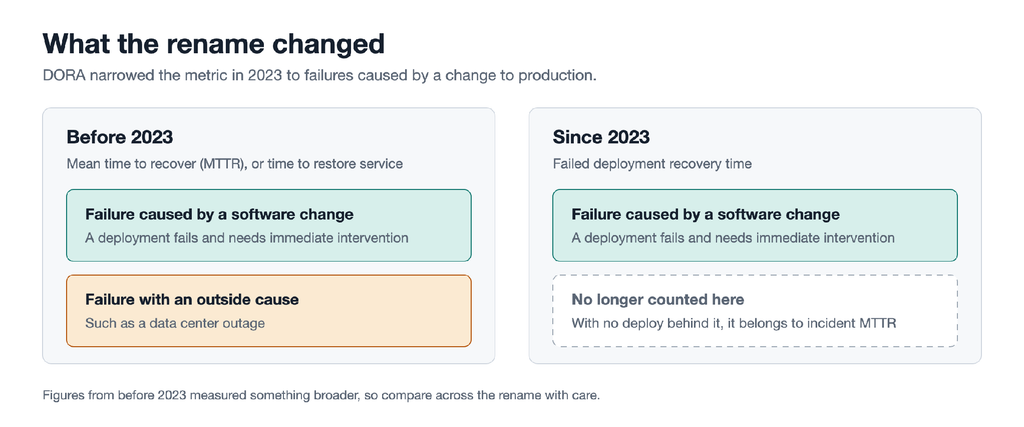
DORA defines the metric as “the time it takes to recover from a deployment that fails and requires immediate intervention.” Only failures caused by a change to production count. An outage with no deploy behind it belongs to incident MTTR.
Until 2023, DORA called this metric mean time to recover (MTTR) or time to restore service, and many teams still say mean time to recovery. DORA renamed and redefined it because the old definition didn’t separate failures caused by a software change from outside causes, such as a data center outage. Earlier figures measured something broader, so an improvement across the rename may partly reflect the new definition.
Among the DORA metrics, it has been a throughput measure since the 2024 report, along with change lead time and deployment frequency. Change fail rate and deployment rework rate measure instability.
How Failed Deployment Recovery Time Is Measured
DORA doesn’t release start or stop timestamps, and its benchmarks are survey-based rather than pipeline-based. We assume the following conventions are commonly applied.
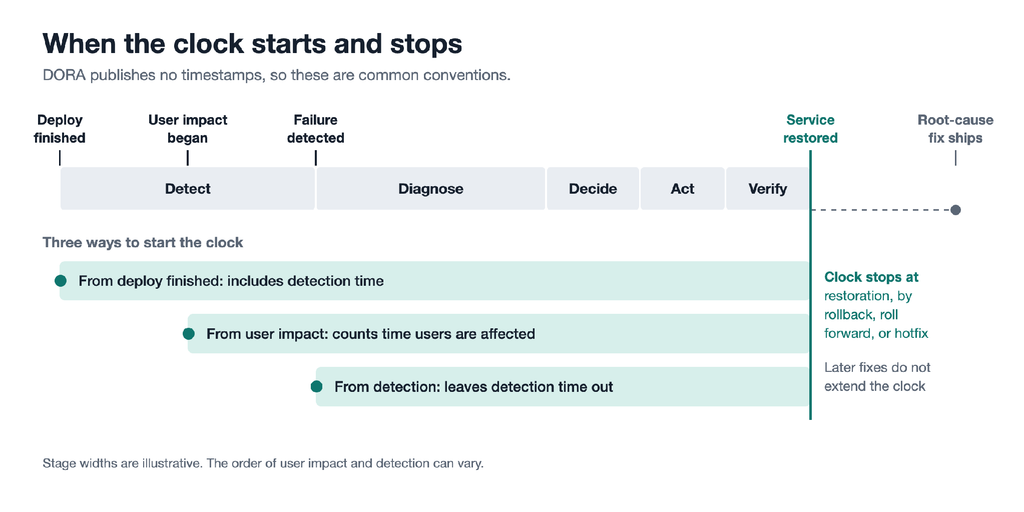
- Clock start: when the failed deployment finished, when the failure was detected, or when user impact began. Starting at detection leaves detection time out of the number, while starting when the deploy finished includes it.
- Clock stop: when service is restored, whether by rollback, roll forward, or hotfix. The root-cause fix can ship later without extending the clock.
- Which deployments count: those that needed immediate intervention, the same set change fail rate counts.
- Reporting: indicate whether the figure is a mean or a median, since one outlying long recovery can pull the mean up, and keep the definition consistent so the number remains comparable.
What Happens Between the Failure and the Recovery
A recovery window consists of five steps: detect, diagnose, decide, act, and verify. Detect is when something (or someone) identifies the problem. Often, humans will recognize the problem via symptoms and errors reported to them, but automatic systems can do this as well. The problem can be identified at different points in the system, and a full understanding of it can lead to more efficient recovery.
Diagnosis can take the longest. With a large change, or without signals tied to each deploy, production debugging has to work out which part of the release broke, often from what the incident log captured.
A rollback stops the clock and leaves the work open. If nobody learns which part of the change failed, the same change can fail on its next deployment and count as another failed deployment.
Practices That Shorten Failed Deployment Recovery Time
Teams working to reduce MTTR usually start with these practices.
- Work in small batches. DORA says they shorten feedback on changes, making problems easier to triage and remediate.
- Automate the rollback deployment. Make it a tested pipeline step. DORA treats short time to restore service as a sign of continuous delivery.
- Release progressively. Canary sends a slice of traffic to the new version, so if a failure occurs, fewer users are affected, and the failure is easy to undo.
- Use feature flags. A flag switches a change off without redeploying.
- Tie monitoring to deploy. Production monitoring that marks each release shows a performance degradation against the deploy behind it. DORA calls rapid understanding of what broke a key contributor to time to restore.
Recovering From a Failed Deployment When Agents Ship the Code
DORA’s 2025 report links AI adoption to higher software delivery throughput, often at the cost of stability. Agents open PRs faster than people can review them or watch each rollout, so detection can’t depend on someone watching every deploy. An agent fixing a failed change also needs to know which function regressed, or it may resubmit the same change.
Recovery often stalls on one question: which of today’s deploys did this? Hud answers it while the new version is still taking traffic. Its runtime code sensor learns how each function normally runs, so when one starts failing or slowing down, Hud names it and the deploy behind it and gives your coding agent the evidence to fix it.
FAQ
Should failed deployment recovery time be tracked per service or per team?
Per service. DORA says its metrics are best suited for measuring one application or service at a time, and warns that blending them across teams can be problematic because contexts differ. A single team-wide figure can hide one slow service behind several fast ones.
Does rolling forward count as a recovery?
Yes. The clock stops when service is restored, whatever the method, so a roll forward counts the same as a rollback. It is also an unplanned deployment caused by a production incident, which means it counts toward DORA’s deployment rework rate as well.
How does failed deployment recovery time relate to an error budget?
A failed deployment uses up error budget for as long as it lasts, so faster recovery spends less of it. Once the budget is gone, Google’s example policy halts all changes and releases other than P0 issues and security fixes until the service is back within its SLO.