
Agentic Rollout

Agents are increasingly writing the code you ship. With an agentic rollout, code goes from a PR to serving all traffic, each step checked against real production with regressions being handed back to an agent.
This is significant because 90% of respondents in DORA’s 2025 report use AI at work, and AI adoption still has a negative relationship with software delivery stability. Here is where it works and where it breaks.
What Is an Agentic Rollout?
An agentic rollout is a rollout built for agents. An agent writes the change, each step to full deployment is checked against how the code actually runs in production, and regressions go back to an agent with the evidence.
The rollout encompasses change from a PR ready for review to change serving all traffic, released in stages by canary, percentage, or pod by pod. It has to be staggered, because each step compares the new version with the old one still running alongside it, and an all-at-once release leaves no old version to check against. Agents write the changes and read the checks, writing the fixes in the process, within limits people set
The term is still unsettled. Readers often take agentic rollouts to mean rolling out AI agents across a team, or a release an agent runs alone. This page means neither, and it’s unrelated to reinforcement learning, where a rollout is a sampled training trajectory.
How an Agentic Rollout Differs From a Standard Deployment
The CD pipeline generally remains the same. What changes is who acts and on what evidence.
| Aspect | Standard deployment | Agentic rollout |
|---|---|---|
| Writes the change | A developer | An agent. Changes arrive more often, and the reviewer may not have written any of the code |
| Decides to promote | A person watching dashboards | Checks an agent can read |
| Moves the bits | The CD system | Usually the same CD system |
| Fixes a regression | The team that shipped it | A coding agent, from the evidence |
| Stays with people | Everything | Accountability, the approval policy, and the agent’s limits |
An agentic rollout is an extension of progressive delivery, which James Governor at RedMonk coined in 2018. Agents speed up delivery, and the bottleneck is moving from writing code to trusting it.
Stages of an Agentic Rollout
Tools name these stages differently, and a canary deployment is one way to run stages two to four.
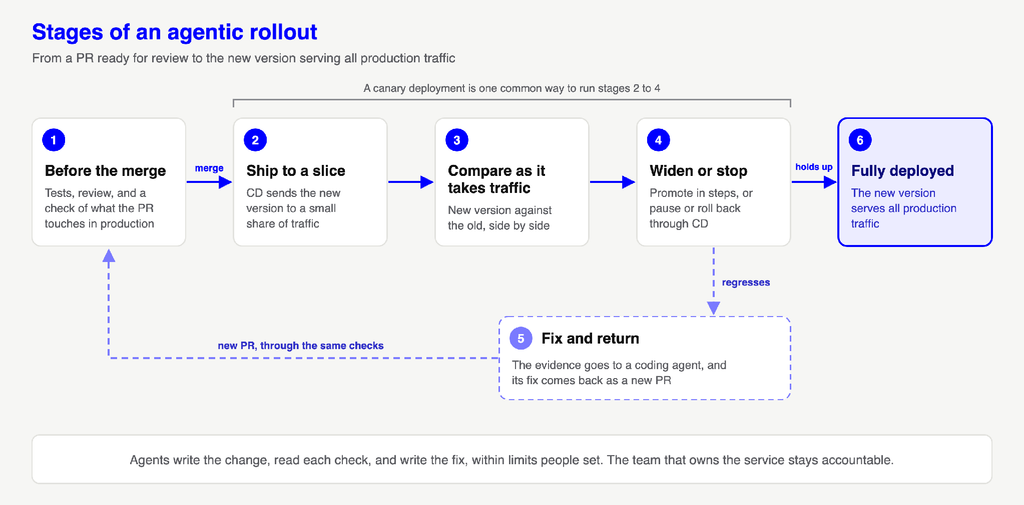
Before the merge: Tests, review, and a check of what the agent’s PR touches in production (which functions, their traffic, their callers) decide whether it merges.
- Ship to a slice: CD sends the new version to a small share of traffic.
- Compare as it takes traffic: Judge it against the old version running alongside, not last week, since Google’s SRE Workbook shows before-and-after comparisons can mislead.
- Widen or stop: Promote in steps while it holds up, pause or roll back through CD as appropriate.
- Fix and return: The evidence goes to a coding agent, and its fix is returned as a PR for the checks to be repeated.
- Fully deployed: The rollout ends when the new version serves all production traffic.
Where an Agentic Rollout Goes Wrong
The usual failures come down to weak evidence or unclear limits.
- Averages that hide a bad slice: In the SRE Workbook’s example, a 5% canary failing 20% of requests shows up as a 1% error rate overall.
- Weak comparisons: Before-and-after numbers lump together change with typical fluctuations in daily and weekly traffic, and a small or short canary can promote with little or no evidence.
- Blind checks: A 200 OK can hide a caught exception, and the slowness of one function can get lost in the averages of the overall service.
- No clear limits: Nobody has defined what the agent can or will do on its own, or rolling back isn’t built into the CD.
- Fixes from guesses: The agent gets the diff and an alert, without evidence from the run that failed.
- Skipped configuration: In the same chapter, it says that a majority of Google’s incidents are triggered by binary or configuration pushes, meaning configuration needs the same type of rollout as code.
What an Agentic Rollout Needs: Production Context and Guardrails
Prior to an agent running a rollout, a team building out an AI software factory needs five things. An AI software factory runs the path from prompt to production as one system, with agents writing the changes and automated checks deciding what moves forward, within rules people set.
- A baseline: A means to measure the normal behavior of code the change touches, before the rollout starts.
- Comparison at the change: At the functions the change touched, not only in service-wide averages.
- A way to act: CD that can pause or roll back, plus written rules on when the agent acts alone and when a person approves.
- Readable evidence: The call graph, request, and exception behind a regression, in a form a coding agent can pull.
- Accountable people: The team that owns the service owns the rollout, whoever wrote the code.
At Hud, we bring runtime context to every rollout with a runtime code sensor that counts every call to every function in your backend services, with minimal overhead, and learns each function’s baseline. Hud checks the PR before the merge, compares every function with its baseline as the new version takes traffic, and names the function and the deploy when one regresses, with evidence your coding agent can pull over Hud’s MCP. It runs alongside your CD and APM and doesn’t move the bits itself.
From PR to Trusted Release
An agentic rollout changes who evaluates the evidence and writes the fix, and leaves the rest of the release practices unchanged. Additional terms are agentic SDLC, AI SDLC, and other terms in the glossary. Try Hud on your next rollout.
FAQ
Does an agentic rollout still need a human approval step?
For risky changes, yes. A written policy determines what an agent is permitted to promote or roll back alone and what requires approval. A reasonable default keeps a human gate for high stakes actions such as merging a pull request or deploying to production, and allows checks to drive the remaining actions.
How do teams measure whether an agentic rollout succeeded?
A single rollout succeeds when the new version reaches all traffic without a regression in the code it touched. Over time, teams track two of DORA’s software delivery metrics, change fail rate (deployments needing immediate intervention) and deployment rework rate (unplanned deployments caused by a production incident).
Are agentic rollouts limited to backend services?
No. Any changes (e.g., code updates for the frontend, new mobile releases, and configuration changes) that are released in a staged manner and can be assessed against the current version of the service being delivered can follow this pattern. Only the evidence is different, as a browser or phone reports different information than a server.
Who is accountable when an agentic rollout causes an incident?
The team that owns the service. An agent can write the change, read the checks, and draft the fix, but accountability stays with the people who set its limits and approved its policy. That’s why those limits belong in writing, reviewed like any other change.