
Agentic SDLC

Today AI coding assistants have become an integral part of software development. These agents can plan a strategy, inspect the code base, modify files, run checks, and prepare a pull request. They have become so advanced, even the user inputs can be questioned by agents, giving direction, whenever there are contradictions or changes beyond users intent.
And it doesn’t stop there. You may be already using Agents for Pull Request review, issue classification, creating documentation and working in various stages of the SDLC. That is why the agentic SDLC is now a delivery topic. Agentic SDLC is here not to replace developers. It is to change where human judgment sits.
What Is the Agentic SDLC?
The agentic SDLC is a software development lifecycle where AI agents perform or coordinate parts of delivery across multiple stages. In an agentic software development lifecycle, agents may help with requirements analysis, task breakdown, code generation, testing, review support, documentation, and release preparation.
This is different from using AI assistants where users typically have to provide input for agents to execute tasks. In the agentic SDLC, agents can act toward a goal across several steps. This does not mean the agent understands the business or architecture by itself.
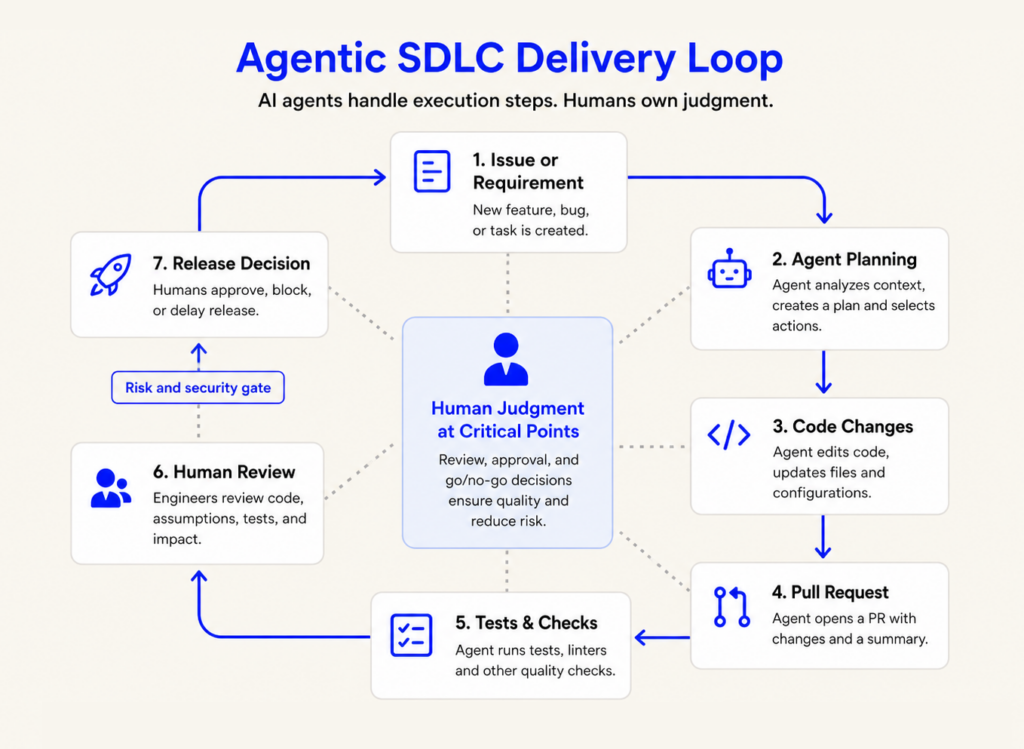
How the Agentic SDLC Differs from the Traditional SDLC
The traditional SDLC follows a familiar rhythm. Requirements are written, developers plan the work, code is implemented, tests are added, pull requests are reviewed, builds run, changes are deployed, and teams monitor production. Even when AI assistants are used in different stages, they do not automatically work as a coordinated workflow. In that model, most judgment and execution sit directly with developers.
In an agentic SDLC, more execution can be delegated to AI coding agents. The developer’s role shifts from writing code to delivering working software. That means reviewing the agent’s assumptions, assessing security impact, understanding runtime behavior, and deciding whether the change is safe to release.
The risk profile also changes. A failure may come from partial context, narrow requirements, weak tests, or code that breaks in production.

How AI Agents Work Within the SDLC
Coding agents usually start with a goal, but the work depends on what they can actually see. They may read nearby files, make a short plan, call tools, edit code, run tests or linters, and adjust the change when something fails. Some stay inside the IDE. Others work through pull requests, CI, issue trackers, or workflow automation.
A developer might ask an agent to implement a small API change. The agent may inspect route handlers, update a schema, modify a service method, add tests, and open a pull request. That helps when the task is narrow, and the codebase patterns are clear.
Most quality issues begin with missing context. An agent may not know the team’s coding standards, architecture boundaries, security constraints, test expectations, deployment rules, legacy decisions, data model assumptions, or ownership lines.
This is where AI-driven observability and runtime intelligence become relevant. Hud brings real-time production intelligence into the developer workflow, helping developers and AI coding agents understand function behavior, errors, and performance directly inside the IDE before a change moves further through review.
Benefits of the Agentic SDLC
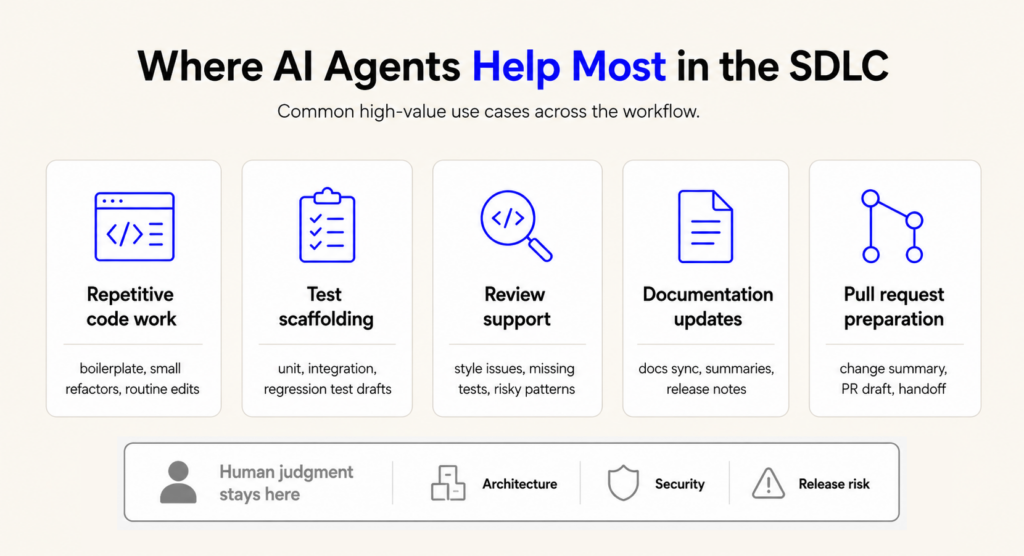
- Faster task execution – Agents can do documentation updates, small refactors, and repetitive edits when the task is bounded.
- Better workflow continuity – An agent can carry a task from issue reading to implementation, tests, and pull request preparation.
- More consistent review support – Agents can check style issues, missing tests, risky patterns, and incomplete documentation before human review.
- Improved test coverage – Testing agents can suggest unit, integration, and regression tests around changed behavior. Developers still decide whether those tests prove the right thing.
- More time for engineering judgment – When routine work is handled well, developers can spend more time on architecture, debugging, production risk, and product tradeoffs.
Risks and Challenges of the Agentic SDLC
Speed is useful only when the output is reviewable. A faster pull request is not helpful if reviewers spend more time untangling broad diffs, shallow assumptions, or hidden side effects.
The main risks are practical. Agents may ignore existing patterns, create branch conflicts, write fragile tests, cross ownership boundaries, or modify more files than the task requires. They can also generate implementations that pass local checks but fail under real traffic or older integration paths. With better context provided for agents, most of these challenges can be addressed.
Security-sensitive changes need stricter gates. Authentication, authorization, payment flows, data access, dependency upgrades, infrastructure changes, and production-facing release logic should still require human approval.
Agentic development also creates governance questions. Teams need to know what the agent was asked to do, which files it modified, what tools it used, and what checks it ran. Without that history, review becomes difficult.
Conclusion
The agentic SDLC is a practical evolution in AI-assisted software delivery, not a replacement for engineering judgment. It can help teams reduce repetitive work and keep development moving, but only when agents work inside clear boundaries.
FAQ
How is the agentic SDLC different from AI-assisted development?
AI-assisted development usually means a developer uses AI for suggestions, snippets, explanations, or local help. The agentic SDLC goes further. AI agents can plan, execute, test, revise, and coordinate multi-step work across parts of the software development lifecycle.
What are the main risks of an agentic SDLC?
The main risks are poor context, shallow validation, security mistakes, unclear ownership, and overtrust in generated output. Agents can move quickly, but they can also produce changes that look correct while missing architecture, runtime, or business constraints.
How do engineering teams keep quality high in an agentic SDLC?
Teams keep quality high by defining agent boundaries, requiring human approval for risky changes, enforcing tests, using code review, tracking agent actions, and feeding agents better context from code, CI, observability, and runtime systems.