Suppose your AI coding agent adds a timezone field to one of your API endpoints. The changes compile, pass all tests, and deploy to production as usual. After some time, you find that for some legacy accounts, the timezone conversion throws an exception. Making things worse, the code catches the exception, and the timezone defaults to UTC. As a result, the API appears to operate normally and returns a success response to the client. The dashboards show everything is healthy.
An AI software factory treats the path from prompt to production as a single system. To reduce production risk, teams need to test both the happy path and what happens when things go wrong. They also need to monitor the system after deployment and be ready to roll back a faulty release. These safeguards matter as AI becomes a regular part of development.
In the 2025 DORA report, 90% of respondents said that they use AI at work. The report also shows that AI adoption still has a negative relationship with software delivery stability. This guide covers the components, the failure points, rollout, and a plan to build a stable, production-safe AI software factory.
Key Takeaways
- An AI software factory is defined by its checks. Repeatable flows and production feedback are what make a factory, not more agents.
- Agents speed up writing code, so review, rollout, and verification become the bottleneck.
- The riskiest failures happen after a merge, in one function, or in one slice of traffic that service-wide metrics average away.
- Grant agents more autonomy in smaller steps, and stop widening when the stability of delivery starts slipping.
What an AI Software Factory Actually Is
The term AI software factory is used in two ways. In the short version, the factory ends at the merge. A coding agent picks up a ticket, writes the code, and gets it through review. The long version continues through release and operations. This guide uses the long version because you only learn whether a change is safe after the merge, once the code handles real production traffic.
An AI software factory has four moving parts:
- Agents write the change.
- Automated checks, such as tests and security scans, decide whether it can merge.
- The rollout checks how the new version behaves as it takes real traffic.
- What production shows goes back to the agents as input for the next change.
What makes it a factory is consistency. Every change goes through the same steps, and every step has a check that can stop a bad change. Adding more agents doesn’t give you either of those. Your timezone change had checks up to the merge: CI and code review. However, nothing checked it after release, so the UTC fallback reached customers, and nobody noticed until a customer did.
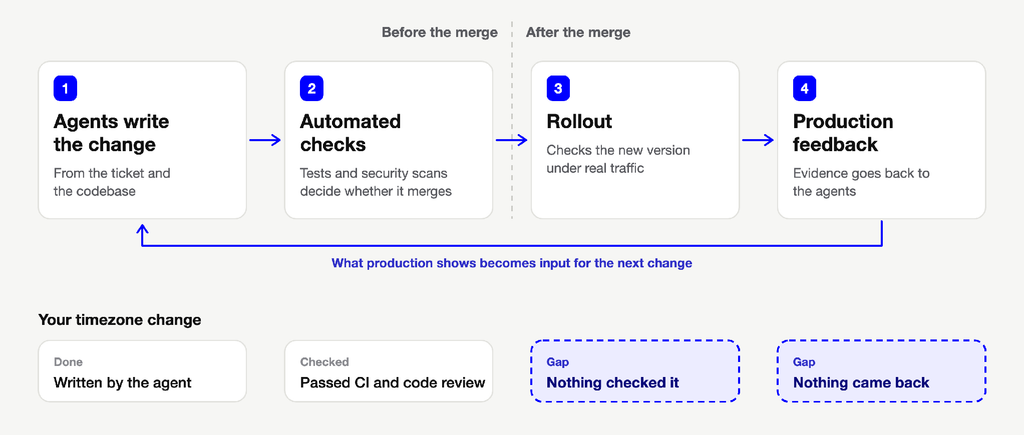
The agentic SDLC is a lifecycle where AI agents perform or coordinate parts of the delivery. A factory is that lifecycle wired in series, with a check in between each step and production fed back to the first.
Why Coding Agents Alone Don’t Make a Software Factory
If your team uses coding agents on a day-to-day basis, you may wonder what’s still missing. Agents generate code and run tests. However, the bottleneck moves to review, integration tests, release, and verification.
DORA also found that AI adoption now has a positive relationship with software delivery throughput, while its relationship with delivery stability is still negative. Teams that use more AI tend to ship more, but less reliably. DORA’s 2025 State of AI-assisted Software Development report explains how both can be true. “AI’s primary role is as an amplifier, magnifying an organization’s existing strengths and weaknesses.” A weak spot after the merge grows as more code flows through it.
As per Stack Overflow’s 2026 Developer Survey, 48% of respondents trust AI output when they can easily verify it. But reading a pull request’s code changes rarely tells you whether the change is safe in production, because that depends on real traffic and real data. Agents send larger changes, more often, and no one on the team wrote them.
AI coding agents have access to the repository and any telemetry you give them, but are typically blind to how code runs in production. The agent working on the timezone ticket read tests that all wrote timezones in the standard format, such as “America/New_York”. Nothing in the repo showed that some older accounts store their timezone in an older Windows-style format, such as “Eastern Standard Time”. The conversion code rejects that format, and that’s the exception from the opening example. Developers writing code by hand have the same blind spot. Agents repeat this across more changes, which is why shipping agentic workflows to production requires more than a powerful model.
The Layers of a Production-Safe AI Software Factory
A production-safe factory has seven layers, and each one is a station with its own check. Several match the capabilities in DORA’s AI Capabilities Model, whose seven capabilities DORA found amplify the positive impact of AI on organizational performance.
- Context: Specs, tickets, internal docs, and codebase context the agent can read. DORA calls this AI-accessible internal data.
- Policy: A written stance on what agents may do alone and what needs a person. DORA’s term is a clear and communicated AI stance.
- Generation: The agents code changes in small batches, so that each change is small enough to be reviewed.
- Pre-merge checks: Tests, static analysis and security scans, plus human review aimed at the changes that carry risk, including what each change will touch in production.
- Version control and rollback: Frequent commits and reliable ways back. As AI increases code volumes, DORA calls version control a critical safety net.
- Progressive rollout: Canary or percentage rollouts that compare the new version with the old one as it takes traffic, with CD that can pause or roll back.
- Production feedback: Evidence from a regression is returned to the agent, and a fix is returned as a PR through the same set of checks.
Under all seven sits a quality internal platform, the automated, secure “paved roads” DORA describes, which gives every team the same route to production. With that in place, production readiness is built into the pipeline itself, because every change that reaches users has passed every layer.
Layer 6 is where the timezone change should have been caught: a rollout that compares each function in the new version with the old and sees the conversion starting to throw.
Where AI Software Factories Break in Production
These are the failure points to expect with agent-written code.
- Review turns into a rubber stamp. Diffs arrive faster and larger than reviewers can read, so an approval no longer means someone understood the change.
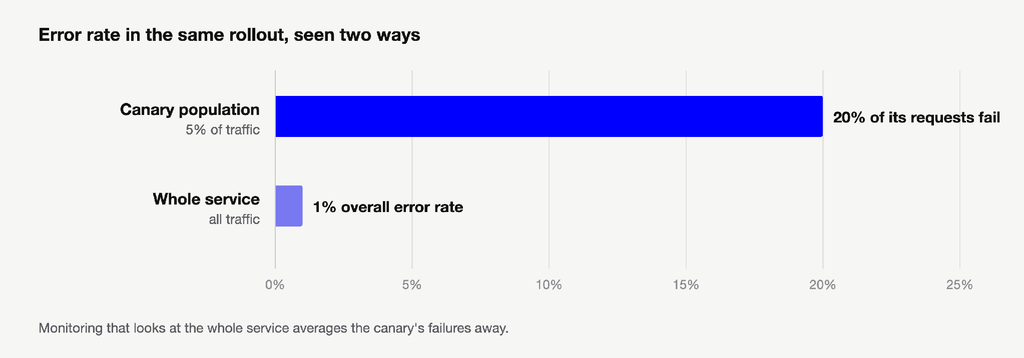
- Service-wide checks miss local regressions. In the SRE Workbook chapter on canarying releases, a canary that takes 5% of traffic and fails 20% of requests shows up as just a 1% error rate across the whole service.
- Failures don’t look like failures. The timezone change is one of them. In JavaScript, the conversion throws a RangeError, and the catch returns values in UTC. Every response is 200 OK. A slowdown in one code path hides the same way.
- Some changes skip the gates. Changes to configuration and infrastructure can bypass the checks your code goes through. Google’s SRE Workbook notes that in Google’s experience, “a majority of incidents are triggered by binary or configuration pushes.”
- Fixes are written from guesses. The agent receives an alert along with a diff, but there is no evidence from the failed run, and the log line it needs was never written.
- Ownership is unclear. When agent-written code fails in production, there’s usually no single owner to go to.
- Intent is vague. If the ticket is unclear, the factory builds the wrong thing faster, and checks that confirm the code works won’t catch it.
How to Roll Out an AI Software Factory Without Stalling Delivery
You don’t need all seven layers in place before agents ship anything. Roll the factory out in stages, and let your delivery numbers decide when to widen it.
- Record a baseline first. Measure DORA’s five software delivery metrics (deployment frequency, change lead time, change failure rate, failed deployment recovery time, and deployment rework rate) for the services involved.
- Start small, with a single service and one kind of change, like a dependency update or a small bug fix.
- Write the policy before you widen scope. Agents need to know what they may merge or ship alone, and what goes to a person.
- Keep batches small and gates automatic, so people spend their review time on the risky changes.
- Put progressive rollout and rollback into your CD before agents ship more often. Continuous deployment stays safe only when a bad version can be stopped while it serves a small slice of traffic.
- Gradually widen to cover more types of changes, services, and levels of autonomy without letting change failure rate or deployment rework rate rise.
- Review the numbers on a fixed cadence, and stop widening when stability slips.
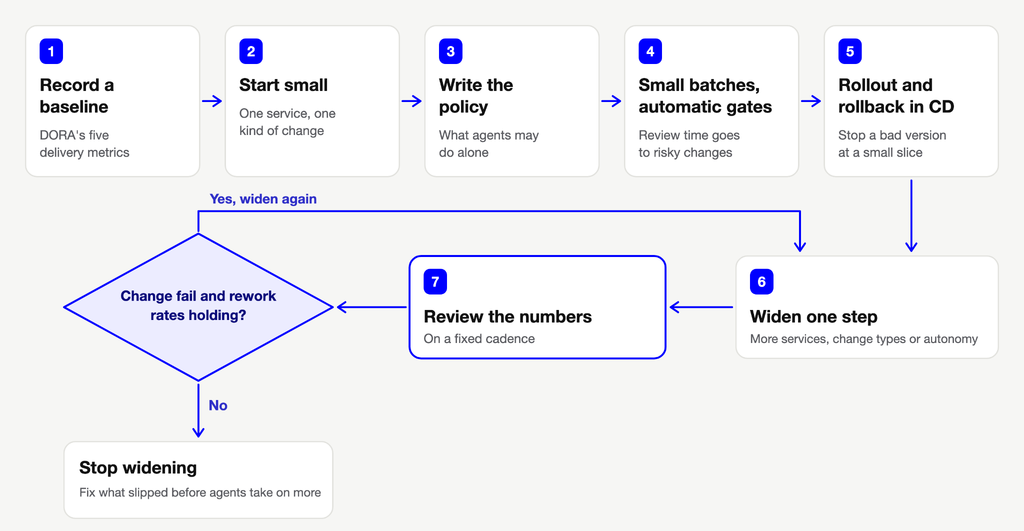
Judge progress by those delivery results. Counting how many steps no longer involve a person is a poor measure, because it rewards removing checks.
Giving Agents the Production Feedback They Need
So what does an agent need to know about production before you trust it there?
- Before the merge. How the code it’s changing runs today, which functions it touches, what traffic they carry, and what calls them.
- As it takes traffic. Whether each part of the new version still behaves like the old one, function by function.
- When something regresses. The evidence, meaning the call graph, the request, and, for errors, the exception with its stack trace.
- Where it arrives. In the agent’s own workspace, through tool access such as MCP, so the fix starts from evidence instead of a guess.
For the timezone change, the exception message alone names the value it rejected: Eastern Standard Time, the stored format the agent never saw.
Hud was built for this, and it’s one way to provide runtime guardrails for coding agents. Its runtime code sensor is an SDK you add to each backend service, with no metrics to pick or thresholds to write. It maps how functions call each other, learns each one’s baseline, and captures forensics on an error or a spike.
Hud uses that context at three points from PR to fully deployed. Before the merge, it reviews the PR against how the functions it changes run in production. As the new version takes traffic, it compares every function with its baseline and flags new exceptions, even ones the code catches, like the timezone RangeError. When a function regresses, it gives your coding agent the function name and the evidence over MCP. It runs alongside your CD and APM, and rollbacks stay with your CD.
The Factory Doesn’t Stop at the Merge
Your factory is defined by its flow and its checks from intent to production, not by the number of agents. And it isn’t production-safe until something checks the code as it takes traffic. To find your gap, trace the path from ticket to production and look for the first stage with no check.
See how Hud checks every PR and rollout against how your code runs in production.
FAQ
Is an AI software factory the same as an agentic SDLC?
Not quite. The AI SDLC and its agentic version illustrate where AI does the work in each stage of delivery. A factory describes the connection between the stages with a check in between, and production feeds back to the start. Agents can work in all stages of the delivery without wiring between the stages, and then there’s no factory.
Which parts of the software lifecycle should stay with people?
Intent, high-risk approvals, and ownership. People should write the spec, since an agent builds what the spec says. They should approve high-risk changes (schema migrations, auth changes, etc.) and be accountable for code once it goes live. Agents should be able to do the work in between.
How do you measure whether an AI software factory is working?
Track throughput and instability together, and compare to your baseline. According to DORA, throughput is deployment frequency, change lead time, and failed deployment recovery time, and instability is change failure rate and deployment rework rate. Deployment frequency rising alongside change failure rate and rework rate means the factory is shipping problems faster. PRs or lines of code generated by agents don’t give you that info.
Does an AI software factory replace code review?
No. Automated gates handle the mechanical checks, small batches keep diffs readable, and the rollout catches unexpected side effects. That leaves human review for questions that need judgment, like “Did the code do what the ticket asked for?”
Can a small team build an AI software factory?
Yes, and fewer services mean fewer paths to wire up. Start with one service: use CI for tests, add a canary step to the CD you already run, and write an agent policy. What matters is having a check at every stage, and a small team can do that for a single service.
About authors