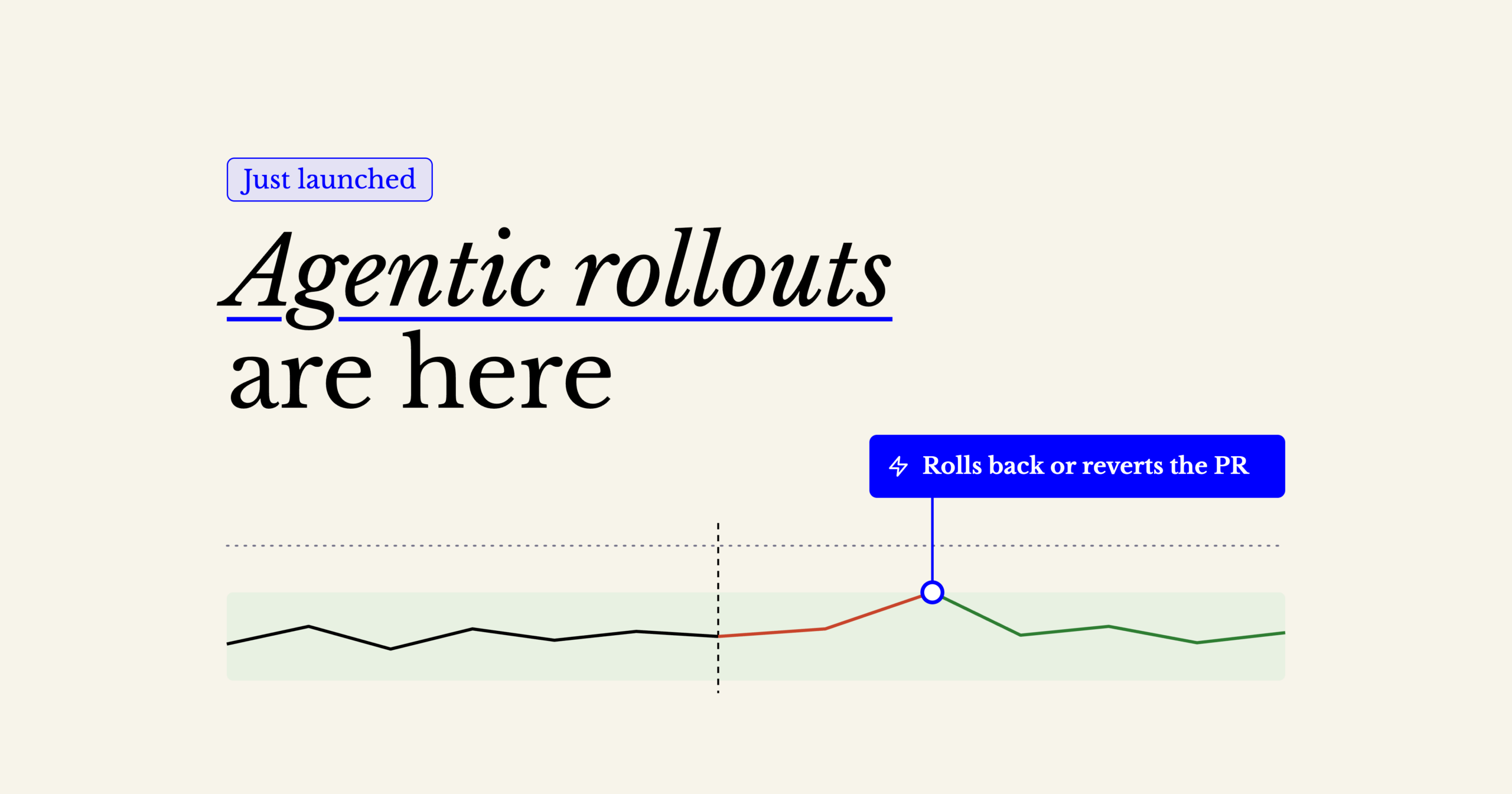
Hud launches agentic rollouts to fix engineering’s biggest new bottleneck: getting AI-written code to production
Coding agents write a change in minutes, but then it can wait for days until enough confidence is built to ship it. Hud analyzes every change against production before, during and after the rollout, so agents can ship as fast as they write when the PR is safe to merge, and receive a feedback loop straight from production so they learn and improve.
NEW YORK, 29/10/2026: AI made writing code fast, but shipping it safely has become the biggest bottleneck in engineering. Hud today launched agentic rollouts to alleviate it and bring the speed of shipping closer to the speed of coding. Coding agents can now take a change from PR to production, with Hud validating every step against how the code actually runs in reality. Before the merge, Hud analyzes PR to classify it as safe to merge or risky. As a new version hits production, Hud closely watches the behavior at the function-level. Regressions are caught immediately, with Hud rolling back or reverting, with the deep context needed for the software factory to fix the underlying issue and learn from such regressions.
The biggest new bottleneck in engineering
Every engineering team is working on building an AI software factory. Agents plan, write and test code, and open the PR in minutes. Then everything slows down. The PR waits for someone willing to merge, because it’s difficult to trust an agent to ship without breaking production, and the agent can’t see how its code runs there.
So the fastest part of engineering now feeds straight into the slowest. Reviewers approve PRs they didn’t have time to read, and someone must keep an eye on dashboards after the deploy. Every team that adopts AI hits this wall, and the more code agents write, the higher it gets. That’s the missing link in the AI software factory: agents build fast, but they’re blind to production.
AI is now part of almost every engineer’s day, but the velocity gains are confusing. Engineers heavily using AI produce twice as many PRs, but each one takes twice as long to review! (details: teams with high AI adoption merge 98% more PRs while PR review time rises 91%, Faros AI (2025), a vendor survey) And the rollout process has not caught up: only 6% of organizations describe their continuous delivery as fully automated (Harness (2025), a vendor survey).
How agentic rollouts work
An agentic rollout is a rollout built for agents. Hud’s runtime code sensor, a one-line SDK, automatically learns the baseline behavior at the function level. Hud uses that runtime context at every stage:
- Before the merge, Hud analyzes the PR against a production impact map with real parameters and code flows, classifying its production risk level – and in cases where it’s risky – provides clear context that speeds up the review process.
- As the new version takes traffic, Hud constantly analyzes the behavior of the new code against the baseline – so regressions can be caught immediately, and the function-level context allows detecting both the root cause and the PR that caused the issue.
- If a regression occurs, Hud’s context allows rolling back, reverting and fixing the underlying issue, while providing the coding agent with deep context to not repeat such mistakes.
Teams know the production-level impact of each change – before, during and after the rollout.
Riverside reverts flawed deploys in about eight minutes
Riverside, the platform for recording and editing studio-quality audio and video, ships fast with AI, and much of its backend is real-time media code that only shows its true behavior under production load.
Riverside runs every deploy through a canary, with Hud’s agentic rollout and automatic rollback. Flawed deploys are detected quickly and reverted in about eight minutes , usually before a customer notices.
“Our engineers use AI agents every day, and writing code is no longer the bottleneck. The real challenge is shipping that code to production with confidence.
For a real-time media platform like Riverside, even a small regression can have a major impact on the user experience. With Hud, we can automatically detect regressions and roll back problematic releases in minutes. Our engineers now spend less time worrying about deployments and more time building.”
Shilo Magen, VP of R&D, Riverside
The missing link in the AI software factory
“AI already changed how code gets written. The bigger problem now is getting that code into production safely, at the speed agents write it. Every engineering leader I talk to is trying to solve this problem. Coding and triage have agents, but the merge and rollout still run on people, because it’s scary to give coding agents accountability over the stability and reliability of the production environment. That’s the missing link in the AI software factory, and it’s the problem we built Hud to solve. With agentic rollouts, agents and engineers work from the same runtime context, at the function level, so a change is merged to production based on evidence. When something does regress, it’s immediately detected and fixed, but more importantly the agent that wrote it gets a feedback loop to learn and improve.”
Roee Adler, Co-Founder & CEO, Hud
That feedback loop is where Hud is headed: every rollout teaches the coding agent how its changes behave in production, so the next change ships with less risk than the last. Agentic rollouts are available today to all Hud customers.
About authors