
How does continuous deployment increase the risk of production regressions?
Continuous deployment helps teams ship smaller changes faster. That is useful, especially when releases are small and easy to trace. But it also shortens the distance between a code change and production. When every approved change can automatically move through the continuous delivery pipeline, weak checks become more expensive. A mistake that once waited for a release window can reach users within minutes.
Why Continuous Deployment Increases the Risk of Production Regressions
A production regression occurs when a new change breaks, slows, or weakens something that previously worked. In continuous deployment, this risk increases because there is less time between merge and release.
That does not mean continuous deployment is inherently unsafe. The problem arises when the pipeline checks only basic signals: the build passes, unit tests pass, linting passes, and the service starts. Those checks matter, but they do not always catch real production behavior.
A change can pass every test and still fail with real data, real traffic, feature flags, background jobs, or external services.
How High-Frequency Releases Change the Continuous Delivery vs. Continuous Deployment Tradeoff
Continuous delivery keeps software ready to release, but a human usually decides when to push it. Continuous deployment removes the need for a manual release decision after the pipeline passes.
With high-frequency releases, teams no longer handle a single large batch every few weeks. They may ship many small changes per day. Each change may seem safe in isolation, but production systems are connected. A frontend update can depend on the shape of an API response. A backend change can affect a queue. A config update can expose an old code path.
The pipeline has to prove more than “the code compiles.”
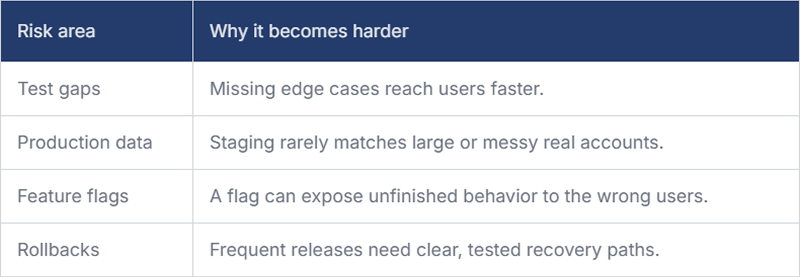
The issue is not just release speed. It is released at speed without enough confidence around the change.
Common Failure Modes in a Continuous Integration Deployment Pipeline
Most production regressions are not caused by dramatic failures. They come from normal gaps in the continuous integration deployment pipeline.
A test may validate a helper function but not the full workflow. Staging may be too clean. A canary may run for too short a time. A rollback may work for code but not for a database migration.
Common gaps usually show up in a few places:
- Workflow gaps – A payment helper may pass tests, but checkout can still fail when retries, inventory checks, and order creation run together.
- Clean staging data – Test environments often lack historical records, large tenants, unusual permissions, and real user behavior.
- Shallow health checks – A service may be running while latency, errors, or failed jobs are already getting worse.
- Untested rollback paths – Reverting code may not fix schema changes, cache formats, or queued work.
These problems are easy to miss in pull requests because the change looks minor. The regression appears later, when the change interacts with the rest of the system.
Why Runtime Signals Matter After Deployment
Continuous deployment needs fast feedback after release, not just before. Tests reduce risk before production. Runtime signals show whether the change is actually safe after users interact with it.
Teams need real production signals, and Hud can bring that context into the IDE so developers and AI coding agents can understand function behavior, errors, latency, and performance issues faster. The question is simple: Did this deployment make production worse?
When that answer is unclear, small regressions can stay hidden. They may not cause a full outage. They may only slow one endpoint, break one tenant, or delay one background process. That still matters.
Reducing Regression Risk Without Slowing Every Release
The goal is not to turn continuous deployment back into a slow, manual process. The better approach is to add controls where regressions are most likely to escape.
That usually means stronger integration tests for critical workflows, safer feature-flag ownership, realistic staging data where possible, canary releases, clear rollback plans, and alerts tied to user-facing behavior.
The continuous delivery pipeline also requires maintenance. Tests grow stale, alerts become noisy, and deployment scripts accumulate exceptions. If no one owns that system, confidence quietly erodes.
Final Thoughts
Continuous deployment increases the risk of production regressions because changes reach real users faster. That speed is useful, but it leaves less room for weak testing, unclear ownership, and slow detection. Fast releases work best when teams can also detect and recover from bad changes quickly. Otherwise, the pipeline only moves problems into production faster.