
What makes MTTD a more actionable reliability metric than MTTR alone?
MTTR gets a lot of attention in reliability discussions. It tells teams how long it takes to recover after something breaks. But recovery time is only one part of the incident story. If a problem sits unnoticed for 40 minutes, a fast repair does not fully protect users. That is where MTTD becomes more useful as an action metric.
Why MTTD Matters for Modern Reliability Engineering
MTTD, or mean time to detect, measures how long it takes a team to notice that something is wrong. It starts when the issue begins and ends when the team becomes aware of it.
That makes it different from MTTR. MTTR starts after the team already knows there is a problem. So, when teams track only repair time, they can miss a large part of the customer impact.
For example, a checkout API may start returning intermittent 500 errors at 10:00. The on-call engineer is paged at 10:25. The fix is deployed by 10:40. On paper, the repair took 15 minutes, but users were affected for 40 minutes.
MTTD vs. MTTR: How Faster Detection Reduces Customer Impact
The relationship between MTTD and MTTR is simple but often misunderstood. MTTR tells you how quickly the team can respond and recover. MTTD measures how quickly the system notifies the team of an issue worth responding to.
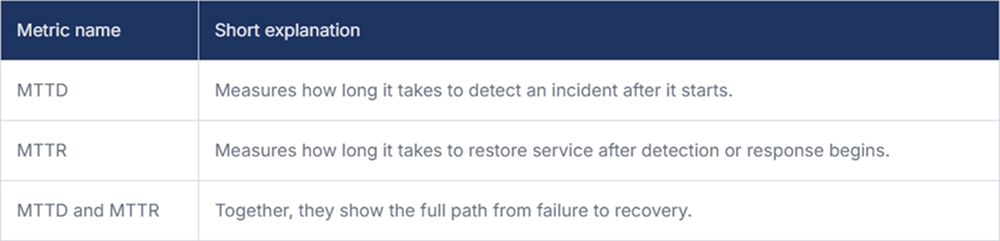
A low MTTR can still mask poor reliability if detection is slow. Teams may feel efficient because they fix incidents quickly once they are visible, but customers may already have spent too long in a broken flow.
Why MTTR Alone Can Create the Wrong Focus
MTTR often pushes teams toward faster repair workflows, which is useful. Runbooks, rollback paths, feature flags, and clear ownership all help during an incident.
But MTTR alone can also create a narrow view of reliability. It rewards speed after an alert fires, regardless of the quality of the signal that triggered it.
A team might improve MTTR by making rollbacks easier, while still overlooking that many issues are discovered through support tickets rather than monitoring. That is not a minor detail. It means users are serving as the detection system.
A practical reliability review should ask questions like:
- Did monitoring catch the issue, or did customers report it first?
- Did the alert point to the right service or only show a general symptom?
- Was the first alert useful, or did engineers spend time filtering noise?
- Were there missing signals that should be added after the incident?
These questions make MTTD more actionable than a repair-only metric. It leads teams back into the system design, not just the response process.
How Observability and Alerting Directly Influence MTTD
Good observability reduces MTTD by giving teams better ways to detect abnormal behavior early. Logs, metrics, traces, synthetic checks, and user journey monitoring all play a role, but only when they are tied to real failure modes.
A dashboard full of graphs does not automatically improve detection. Engineers need signals that map to user impact and service behavior. The same applies to latency. Average latency may look fine, while p95 or p99 latency is hurting critical flows. Detection improves when alerting aligns with how users actually experience the system.
This is where reliability work becomes more concrete. Teams can review past incidents and ask which signal should have fired earlier. Maybe the missing piece was a trace across services. Maybe the threshold was too loose. Maybe the alert existed, but it was routed to the wrong team. Tools like Hud can also help here by bringing real-time production intelligence into the IDE, so developers and AI coding agents can understand function behavior, errors, and performance without leaving the workflow.
Making MTTD Useful in Engineering Reviews
MTTD should not be treated as a vanity metric. It is useful only when teams connect it to incident reviews and system improvements.
After an incident, the review should separate detection time from repair time. If detection took longer than repair, that is a strong sign that monitoring needs attention. If detection was fast but repair was slow, runbooks, ownership, deployment safety, or rollback paths may need work.
This split keeps the discussion honest. It avoids lumping every reliability problem under a single broad “we need faster recovery” label. For teams working with distributed systems, MTTD and MTTR together give a better picture of operational health. One metric shows how quickly failure becomes visible. The other shows how quickly the team can act once it is visible.
Final Thoughts
MTTR is still useful, but it is not enough on its own. MTTD shows whether the team can see failure early, before customer impact becomes too severe. That makes it a more actionable reliability metric in many engineering environments. The best reliability work usually starts before the fix. It starts when the system becomes clear enough to indicate that something is wrong.