
How does AI code review complement production runtime monitoring?
AI code review and production runtime monitoring address different parts of the same problem. One looks at code before it ships. The other watches what happens after real users, traffic, and data interact with the system. Neither is sufficient alone. Used together, they give engineering teams a better way to catch weak changes early and learn from production behavior later.
How AI Code Review Bridges the Gap Between Static Analysis and Runtime Monitoring
Static checks are useful, but they only see what exists in the code. They can catch unsafe patterns, missing validation, risky dependencies, repeated logic, or functions that may become hard to maintain later.
AI code review adds another layer to this. It can read a pull request in context and point out changes that may cause problems later. For example, it might notice a retry loop with no backoff, or a new API path that does not use the existing authorization helper.
But it still does not know everything that production runtime monitoring reveals that the parts code review cannot fully predict. Latency spikes, memory growth, failed background jobs, noisy database queries, unexpected user paths, and edge cases from real traffic all surface after deployment.
A simple way to separate the two is this:
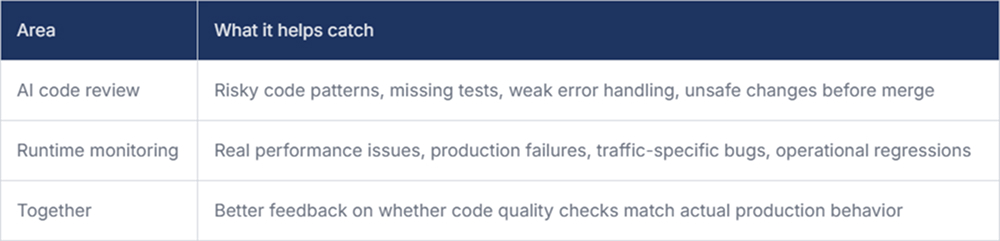
This is where the two systems start to complement each other. The review catches likely issues before merging. Runtime monitoring confirms which issues actually matter once the code is running.
Code Review Before the Incident
A good review process should not only ask, “Does this code work?” It should also ask whether the change will behave well when something around it fails.
That is where AI code review becomes useful for production-facing work. It can analyze a pull request and point out things that often become runtime problems later:
- Missing timeout handling in calls to external services
- No logging around failure paths
- Broad exception handling that hides useful error details
- Queries that may work locally but become expensive at scale
- Changes that skip existing observability conventions
These are not always bugs in the strict sense. The code may pass tests. It may even look fine in a quick human review. Still, these small gaps often become painful during an incident.
Runtime Monitoring After the Merge
Production runtime monitoring reveals an uncomfortable truth. It shows whether the assumptions made during review hold up in production. A pull request may look safe, but after release, the service starts throwing intermittent 500 errors. Or a new validation rule increases the number of support tickets. Or an endpoint that looks simple can put pressure on a database table during peak traffic.
Runtime monitoring makes those signals easier to trace. Logs, traces, metrics, exceptions, and alerts show how the system behaves after leaving the review environment. Tools like Hud can add some of that context inside the IDE, so developers and AI coding agents can check function behavior, errors, and performance while working through a change.
Building a Feedback Loop Between AI Code Quality Checks and Observability Tools
The strongest setup connects review findings with runtime evidence. A timeout issue in production should not stay only in the incident notes. It should change how future pull requests are reviewed, especially around outbound calls, timeout defaults, retry behavior, and missing circuit breakers.
This feedback loop can be simple:
- A production issue appears in monitoring.
- Engineers identify the code pattern behind it.
- Review rules or prompts are adjusted.
- Similar future changes get flagged earlier.
This is not about making AI the final reviewer. It is about giving it better context. Runtime monitoring provides the evidence, and AI code review helps apply that evidence earlier in the workflow.
Where Engineers Still Need Judgment
There is still a risk of noise. AI may flag acceptable code, and monitoring may generate alerts that do not matter. Both systems need tuning. Engineers still need to decide whether a warning is useful, whether a metric is meaningful, and whether a fix is worth doing now. Context matters. A slow internal admin job is not the same as a slow checkout request.
The best use of AI code review is not to block every suspicious change. It is to surface reasonable concerns while the code is still inexpensive to change. The best use of runtime monitoring is not to collect every signal. It is to show what affects reliability, performance, and users.
Conclusion
AI code review helps teams catch likely problems before code reaches production. Production runtime monitoring shows what actually happens once it does. Used together, they create a practical feedback loop. Review gets smarter from production signals, and Monitoring becomes easier to act on because future code starts with fewer obvious gaps.