
Chaos Engineering

Chaos engineering is the practice of testing a system by making parts of it fail on purpose. You run these experiments to find the failover that doesn’t fail over, or the timeout that turns one slow service into an outage, before a real failure does.
Netflix described Chaos Monkey as “a tool that randomly disables our production instances to make sure we can survive this common type of failure without any customer impact.” This page covers where the practice comes from, the common experiments, and what changes when AI agents ship the code.
What Is Chaos Engineering?
The Principles of Chaos Engineering define it as “the discipline of experimenting on a system in order to build confidence in the system’s capability to withstand turbulent conditions in production.”
The Principles describe five practices as the ideal way to run an experiment:
- Build a hypothesis around steady-state behavior, a measurable output, such as throughput or error rates, that indicates normal behavior.
- Simulate various real-world events, such as a server dying.
- Run experiments in production.
- Automate experiments to run continuously.
- Minimize blast radius, the share of users and systems an experiment can affect.
Fault injection is the technique of introducing a failure on purpose, and chaos engineering uses it inside an experiment. Resilience engineering is the wider field of how systems, and the people who run them, cope with failure.
The Most Common Chaos Engineering Experiments and What They Test
Every experiment introduces one realistic failure on purpose and checks whether steady state holds. Netflix’s 2011 Simian Army post describes three early ones. Chaos Monkey randomly disables production instances, Latency Monkey adds artificial delays to calls between services, and Chaos Gorilla simulates the outage of an entire availability zone. An open-source fault catalog adds network, DNS, HTTP, and resource faults. Each is a form of fault injection aimed at one hypothesis.
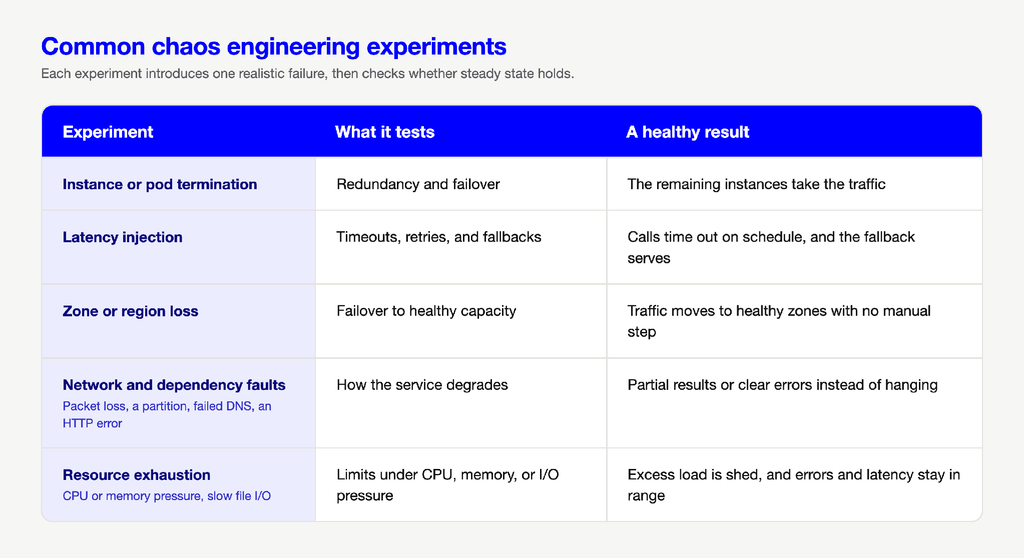
Let’s say your product page makes recommendations by calling a service, with a two-second timeout, one retry, and a fallback to a cached list. A latency experiment would slow the recommendations service and check that the page loads using the cached list.
What Chaos Engineering Reveals That Monitoring Alone Cannot
Monitoring shows how your system behaves under whatever conditions happen to occur. An experiment creates the condition on purpose and checks how the system and the team respond, and as the Principles of Chaos Engineering note, “systems behave differently depending on environment and traffic patterns.”
If the recommendations service has never been slow in production, the cached-list fallback has never run, and no dashboard can tell you it works. The same can be said for a retry setting that turns a small failure into a large one, an alert that never fires, or a recovery step that nobody has tried. It’s better to find these issues ahead of time, rather than during an incident while using your debugging tools.
The two still depend on each other. An experiment needs production monitoring to define steady state and read the result, so it is only as informative as the measure it watches, such as the golden signals of latency, traffic, errors, and saturation.
How Chaos Engineering Fits Into AI-Native Development Workflows
Google Cloud’s announcement of the 2025 DORA report found AI adoption has a positive relationship with software delivery throughput but still a negative one with stability.
As agents open more PRs, deployment frequency, which DORA’s metrics guide defines as “the number of deployments over a given period or the time between deployments,” rises faster than a quarterly GameDay, a scheduled failure exercise, can follow. The Principles of Chaos Engineering already say to automate experiments to run continuously. An experiment proves only that a behavior held when it ran, and a later change, from a developer or an agent, can raise the recommendations timeout or drop the cached list.
Where a steady-state hypothesis covers the entire system, Hud keeps a baseline for every function. Our runtime code sensor counts every call to every function, and as a new version takes traffic, Hud compares each function with its baseline. If a refactor makes the recommendations call slow or throw, Hud names the function and the deploy that caused it, and gives the coding agent the evidence to fix it. Hud doesn’t inject faults or run experiments, and works in addition to your APM and chaos tooling.

From One Experiment to Every Deploy
Chaos engineering is designed to prove your system survived a failure when you tested it, and each deploy after that can change the answer. To start, pick one fallback your users depend on, such as the cached list the page shows when the recommendations service is slow, and write down its steady state. Then slow down or break that service for a small share of traffic, and check that the fallback takes over.
See how Hud checks every function against its normal as each new version takes traffic.
FAQ
How does chaos engineering differ from load testing?
Load testing checks how a system copes with expected or peak traffic against a capacity target. Chaos engineering introduces a failure and checks whether steady state holds. The two combine well, since the Principles of Chaos Engineering list “a spike in traffic or a scaling event” among the real-world events to try.
Is chaos engineering safe to run in production?
Within limits. The Principles of Chaos Engineering state that production traffic is best, since systems behave differently there. The engineer is responsible for minimizing and containing fallout. So, safe doesn’t mean no risk; it means a small, controlled blast radius, often a slice of traffic first, as in a canary deployment.
What is the GameDay approach to chaos engineering?
A GameDay is a scheduled exercise in which a team triggers failures on purpose to see how its systems and people respond. A 2012 ACM Queue roundtable says Amazon created GameDay in the early 2000s, with Jesse Robbins as its architect, and describes Google’s equivalent as usually a round-the-clock exercise lasting 72 to 96 hours.
How does chaos engineering improve mean time to recovery?
Not specifically. Rehearsing failures can locate flaws in detection, alerts, and runbooks before an actual case occurs. Therefore, surprises for responders, human or AI SRE tools, are less likely. In 2023, DORA renamed the metric failed deployment recovery time and, as its metrics history states, focused it strictly on changes-related failures. Experiments rehearse any kind of failures.
Can AI agents run chaos experiments autonomously?
Research prototypes can. A 2025 paper by Kikuta, Ikeuchi, and Tajiri describes an LLM-based system that automates a full experiment cycle for Kubernetes systems managed as code, tested on one small and one large system. The Principles of Chaos Engineering still hold the engineer responsible for containing the fallout, so people should set the limits.