Most engineering teams have already started using AI coding tools. Let’s say one of those tools changes the retry logic in a checkout service. The changes are tested and validated. Then what? The pull request gets stuck while three engineers determine who owns the tax provider integration and decode the correct retry policy.
Here’s how AI-first engineering begins: pipelines, permissions, ownership data, validation, and feedback in production. The agents and developers alike use the aforementioned items. Without them, AI will just generate more code for the platform team to manage.
Key Takeaways
- The operating model needs to change. It touches how work gets prepared, reviewed, deployed, and watched once it is live.
- Context has to be readable by machines. Agents need current architecture, owners, policies, dependencies, and production data.
- Guardrails need to run on their own. A rule kept in an onboarding page or in a reviewer’s memory will not stop an agent.
- Agent actions need limits and a paper trail. Every change should carry a known identity, a scope, evidence, and a way to roll back.
What Has to Change at the Platform Level
Context as an Engineering Interface
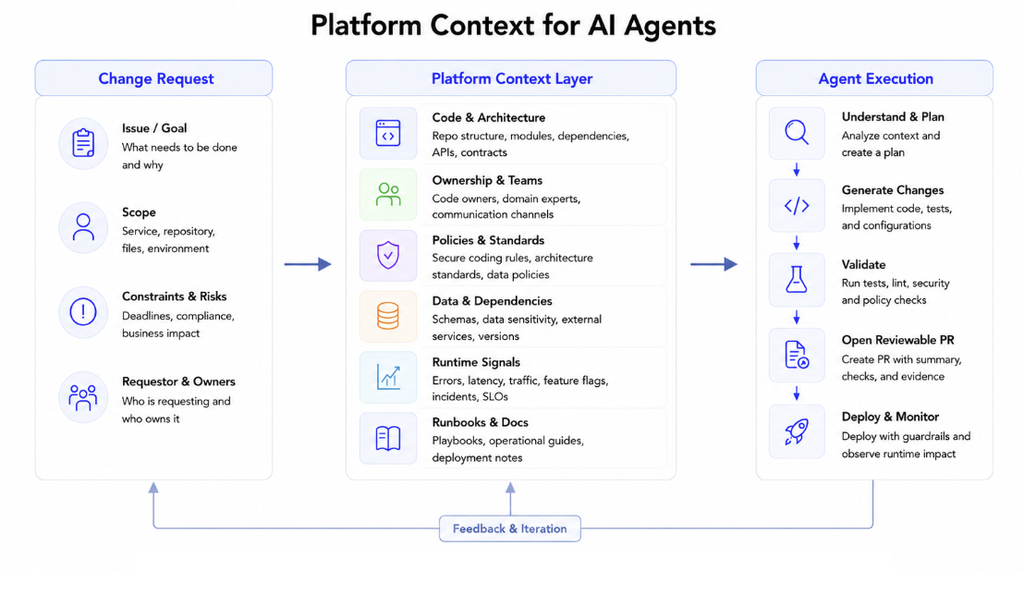
People who have been on a service for a while can recall the major incidents and can surmise dependencies that aren’t written down. A coding agent won’t have that context unless the platform provides it. A useful context layer includes the code repository structure, code ownership and API contracts, deployment artifacts and documentation, runbooks, and runtime signals. The agent can query this context.
More text is not the goal. Fixing checkout retry requires the tax provider contract, shared retry policy, recent timeout incidents, and rollback constraints for that service. A change to the test-fixture probably requires the local conventions and the test command.
Context also needs to have an owner and an expiration signal. An outdated architecture diagram can mislead an agent more than having no diagram at all.
Policies That Run Inside the Workflow
A lot of engineering rules still get passed on by word of mouth. Someone mentions that a certain package needs a security review before anyone can edit it. People also say that records containing customer data need to get redacted with an approved redaction library. An agent was never part of that conversation.
The important constraints need to be turned into checks that run during the course of the work for agentic engineering to work. Distinguish architecture boundaries and styles from safety constraints, because a pipeline that blocks on everything gets noisy, and developers learn to ignore it.
Advice on naming can be left advisory. Restrictions on moving customer data across regions can’t.
Delivery Pipelines Built for Agent Work
Most pipelines assume the change was written by a human who understands the intent of the change. This is not guaranteed when agents are opening PRs.
The platform should keep the request, context, tools, tests, and gate results associated with each change. People reviewing a change to checkout retry should not have to rebuild intent based on a 600-line diff.
Good agentic workflows have a clear trigger, a definable task with edges, and a structured output that an engineer looks at before anything ships. Rather than using prompts copied between engineers, they run from versioned workflow definitions.
A minimum control set usually looks like this:
- defined task boundaries and a list of allowed repositories
- short-lived credentials with narrow permissions
- mandatory tests and policy checks
- human approval for higher-risk changes
- staged deployment with rollback criteria
The pipeline also requires “choke points.” It may let the agent open a draft pull request but stop it from approving the pull request. It may let the agent deploy to an isolated environment and no further. Autonomy can be practiced where the team already understands how things fail.
Runtime Feedback in the Change Workflow
Code is written to show a feature’s functionality. Tests evaluate a few considered cases. Production is where the unknown happens.
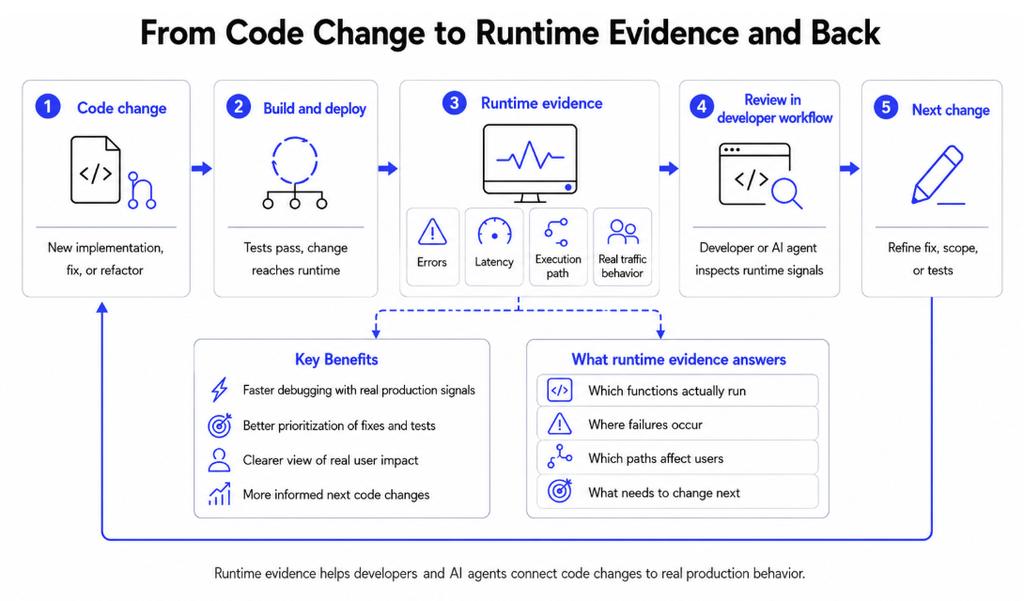
Operational evidence belongs in review. Key signals include call volume, errors, latency, active dependencies, the feature-flag state, and which endpoints call the modified functions. For the checkout fix, the reviewer would want to know whether the retry triggers on every order or only on orders where the tax call times out. Hud‘s Runtime Code Sensor gathers function-level production data and uses it to enhance your IDE and an MCP server by providing devs and AI agents with information on behavior, bugs, and performance.
Identity and Permissions for Agents
Agent work is not secure with shared service credentials. With five different automated tasks using the same token, it’s nearly impossible to identify who did what or why it was allowed. There’s no way to know what the token can access.
Agents must have their own identities or short-lived credentials scoped to a repository, environment, data source, and action. Documentation agents have no reason to view production secrets.
Approval processes can track risk in the same way. For example, a dependency bump in an internal tool can take a much lighter path than a schema migration in the payment service. The platform should represent that difference instead of relying on the reviewer’s memory.
Golden Paths That Cover AI Behavior
Current examples of golden paths are published for services, pipelines, observability, and security. Command lines that are understood and executed by the agent should also be published for build, test, lint, local start, and integration checks. Also, each repository should define its owner(s), data classification, deployment strategy, and operational constraints.
Exception handling is also part of a good platform engineering AI setup. For regulated services, you may need to reduce autonomy or remove write access completely. An AI engineering platform that insists on a single workflow for all repositories will be worked around. It’s better to use a single control model and let each team set the risk, validation, and rollout standards.
What AI-First Engineering Looks Like in Practice
Returning to the checkout service. The issue states that the tax provider has timeouts. Before the agent makes any changes, it gets the service owner, dependency contract, retry policy, test commands, deployment rules, and runtime data.
It finds two implementations of retrying, and one of them goes around the shared retry policy. The agent moves the bypassing one to the approved client wrapper, adds tests for the failure cases, and creates a draft pull request.
| Workflow stage | Platform responsibility |
| Task intake | Preserve intent, constraints, owner, and risk |
| Context assembly | Retrieve current code, policy, dependency, and runtime data |
| Change execution | Restrict tools, credentials, files, and environments |
| Validation | Run tests, policy checks, security checks, and change-specific evaluation |
| Deployment | Use staged rollout, health criteria, and an explicit rollback path |
| Review | Present evidence, unresolved risk, and agent action history |
Once the owner approves, the change is released to a small percentage of the traffic as a canary. The platform records timeouts, latency, and retries as well as downstream load for the canary and the control version. If the health criteria are not met, the release is stopped, and the result is written to the change record.
None of this is a chat window in the IDE. The platform manages context, access, evidence, deployment, and gives feedback. Engineers still make the calls. And somebody still needs to spot the fix that is right for a given file and wrong for the system around it.
An agentic SDLC is characterized by gradually easier handoffs, and accountability remains the same.
- Requirements produce bounded tasks.
- Tasks produce reviewable changes.
- Deployments produce evidence.
Evidence should impact the next change, as opposed to disappearing into a separate monitoring tool.
Where Most Platform Teams Are Getting Stuck
They Distribute Tools Before Fixing the Workflow
Traditionally, the first step is to purchase licenses and to encourage people to experiment. Usage increases. Developers wait on test environments, reviews, security approvals, and owners no one can name, so local activity increases while end-to-end delivery is stalled. Identify where work stalls before adding more generation capacity.
They Treat Documentation as Context
A large internal knowledge base is no substitute for the context needed to perform a given task. The context needed should include a clear source of truth and an owner.
Agents have no way to tell which of the five documents describing the same deployment process is the correct one. It leads the agent to burn tokens, get things wrong, and pull in a human more often. The platform must have source ranking, versioning, and links back to the systems of record.
They Use Prompts as Guardrails
“Follow security best practices” is not a control. Prompts only shape behavior, and the real constraints should sit outside the model. Permission limits, protected branches, test requirements, and staged deployments are easier to audit and harder to skip.
They Grant Broad Access to Avoid Friction
Some teams extend wide repository and cloud access to their agents due to the time it takes to set up and enforce tight permissions. Then workflows are built around it, and it is not easy to take it away.
Small action surfaces should progressively become larger with the introduction of more evidence. Read should not become write. The permission to open a pull request should not be the same permission to merge or deploy.
They Cannot Connect Changes to Production Results
Many teams can say how frequently an AI tool is used. Fewer teams can tell if changes made by an AI tool result in more incidents, more rework, or shorter reviews. Useful measurement follows a change through review effort, escaped defects, deployment failures, rework, and cycle time. With the checkout fix, that means checking if timeouts actually dropped or if the load just shifted to the tax provider.
| Failure mode | What goes wrong | Platform response |
| Tool-first adoption | More code is generated, but existing delivery bottlenecks remain | Fix workflow constraints before increasing generation capacity |
| Documentation treated as context | Agents receive stale, conflicting, or unauthoritative information | Rank sources, assign ownership, and connect agents to systems of record |
| Prompts used as guardrails | Important rules depend on model compliance | Enforce critical boundaries through permissions, tests, and deployment gates |
| Broad agent access | Agent permissions exceed the task being performed | Use scoped identities and short-lived credentials |
| No production feedback | Teams cannot connect AI-generated changes to operational results | Feed runtime and delivery evidence back into review and future changes |
Final Thoughts
Although platform work is less visible than generated code, it determines whether AI scales cleanly. Teams need context and controls that enforce themselves, rather than absolute autonomy. They also need narrow permissions and quick feedback from real systems. Build controls first, and, as evidence supports agentic workflows, widen them. To see your code’s behavior in the real world before it’s shipped to production, try Hud.
FAQ
What is AI-first engineering?
In an AI-first engineering organization, AI is involved at every stage of the software lifecycle, from planning and testing to deployment and operational analysis. The organization modifies its architecture and governance to make that safe. It is not about how many developers have coding assistants.
How is AI-first engineering different from using AI tools?
Using AI tools means adding certain capabilities to your work. With AI-first engineering, the workflow is changed. You develop contexts for machines, implement policies as automated checks, enable traceability for agent actions, control and restrict permissions, and provide production feedback for the changes
What must platform teams change to support AI-first engineering?
They should make changes to provide better context, policy checks, and enable agents to do work via CI/CD. They should also make changes to provide scoped identities, as well as enable reliable build and test commands. With risk-based autonomy, low-risk changes should not share a path with high-risk changes.
How do you know if your organization is truly AI-first?
Organizations need to evaluate control mechanisms for unsafe changes, model allowed agent actions, audit action logs, and define the outcomes agents produce. True AI-first engineering improves the overall speed and quality of work and doesn’t mask increased operational effort and costs.
About authors