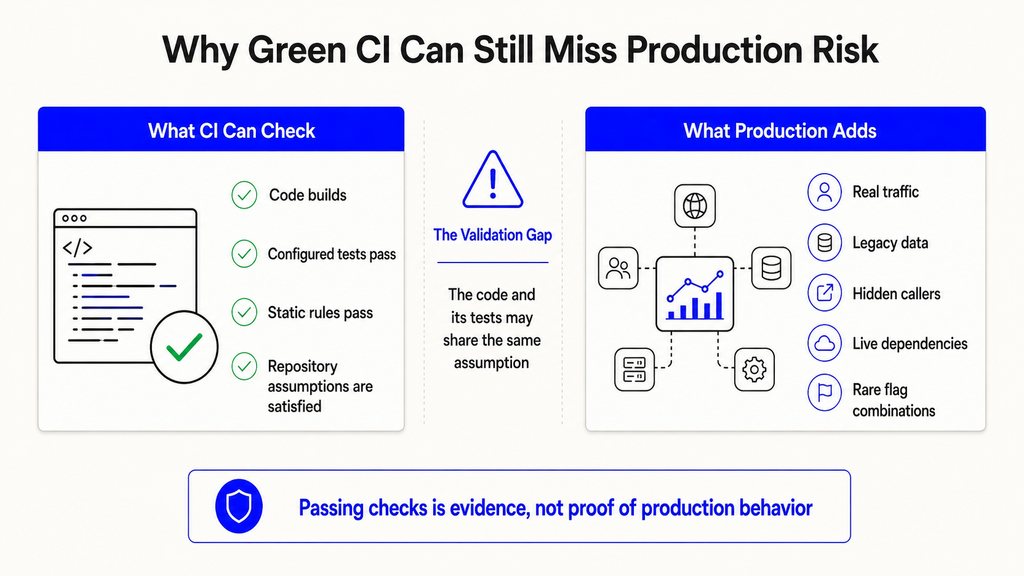
The PR was only 14 lines. An agent tightened the retry logic in a payment helper, added tests for timeouts, and every check went green. That afternoon, checkout started failing. The provider was returning HTTP 429 with a Retry-After header, a case no test covered, because the agent wrote the tests using the same assumptions it wrote the code from. CI answered a smaller question than the one you were asking.
AI coding agents produce pull requests faster and in greater volume than reviewers can comfortably inspect line by line. The code may compile, and the tests may pass, yet the difficult question remains. Does the change match the behavior of the system that is already running in production?
This article focuses on that validation step. The problem is not only whether an agent generated incorrect code or used incorrect assumptions. It is whether a completed AI-written PR can be checked against real production behavior before merge, then verified again during rollout.
Key Takeaways
- A successful continuous integration (CI) run on a pull request confirms that the executed checks passed. It does not establish that those checks cover production conditions.
- When the required telemetry is available, runtime evidence can reveal hot functions, active callers, error patterns, performance baselines, and dependency paths before approval.
- Code review, static analysis, and runtime validations catch different failure classes. No single layer can replace the others.
- Before merge, use existing production behavior to assess risk. After deployment, expose the new version to a small traffic group and expand only when the agreed checks pass.
- Low-risk PRs can move quickly, while changes to busy or failure-sensitive paths require deeper evidence.
Why AI-Generated PRs Break in Production Even When Tests Pass
Tests are typically executable assumptions. They cover the inputs and interactions. When an agent learns those assumptions from the repository it modifies, it can reproduce the same blind spot in the code and tests.
This reflects a longstanding software-testing problem because tests still need a reliable source of expected behavior. A model can change code, update a fixture, and test its own interpretation. As a result, the pull request can still show a passing CI status because the code and its tests agree, not necessarily because either one matches production behavior.
The Test and the Implementation Share the Same Blind Spot
Suppose an agent changes a payment retry helper. Tests cover timeouts, but the provider can also return HTTP 429, meaning too many requests, with a Retry-After header indicating how long to wait. Does the helper respect that delay, or retry immediately and add more load?
The expected behavior should come from the provider’s API contract and reviewer-approved retry rules. Independently maintained contract tests check agreed interactions between services. They give reviewers a reference that was not simply generated to match the new implementation.
Repository Context Does Not Show Operational Importance
A tiny diff may sit on a heavily used path. A new default can affect thousands of requests. The payment retry PR shows the problem: the diff is small, but the helper sits on the checkout path, so a behavior change can affect far more requests than the line count suggests. Static analysis finds references, but it’s not a complete representation of real traffic.
The reverse also happens: a large diff may touch cold migration code. Treating both changes alike wastes effort on one and understates the other’s blast radius.
Production Inputs Are Messier Than Fixtures
Real systems contain old records, unusual payloads, and dependency failures. Test fixtures are prepared data and setup conditions used to make tests repeatable, such as a sample payment response or database record. They can leave important production combinations untested.
For example, an agent makes a locally reasonable optimization that changes ordering or retry behavior under load. It works correctly on small datasets used in tests but might degrade when processing thousands of requests in production. Nothing is syntactically wrong, and the existing unit tests may still pass.
The Signals That Reveal Whether an AI PR Is Safe to Merge
Before merge, production evidence identifies the existing behavior a change could affect. After deployment, a canary release sends a small portion of traffic to the new version for comparison. Progressive delivery expands exposure in stages, while a feature flag controls which users receive a behavior. These mechanisms limit exposure while monitoring the result.
The most useful signals are:
- Function activity: How often does the changed code run, and when does it peak? Hot functions deserve more scrutiny than dormant paths.
- Caller and callee relationships: Which active functions lead into the code, and which databases, APIs, or middleware sit downstream? This exposes hidden blast radius.
- Latency distribution: p95 and p99 are the response-time thresholds at or below which 95% and 99% of observed requests finish. Track these slower requests because averages can hide delays affecting part of the traffic.
- Error behavior: Which exceptions occur, how often, and where are they handled? New logic may turn a recoverable error into an unhandled one.
- Branch and feature usage: Which paths and flag states receive real traffic? Tests should cover active combinations first.
- Deployment deltas: Did earlier changes alter duration, errors, or call patterns? A sensitive area needs stronger validation next time.
For the payment retry PR, those signals help answer different questions: how often the helper runs, which checkout paths call it, where provider failures already occur, and whether retries are associated with latency or downstream pressure.
These signals should be read together. High volume alone does not make a change unsafe, and an existing exception is not a regression. Risk rises when a hot function also has many downstream callers and unstable tail latency.
This is where runtime monitoring adds information a diff cannot provide. Hud collects function-level invocation counts, execution durations, exceptions, and caller/callee relationships and exposes that runtime context in the IDE, through MCP, and in agentic workflows. For pull requests, Hud’s Blast Radius workflow maps changed functions to their production usage and produces a 0–100 Blast Radius Score with a Low, Medium, High, or Critical risk level. The score provides decision support for reviewers or deployment gates rather than acting as an automatic merge approval.
How to Build a Pre-Merge Validation Workflow for AI-Generated PRs
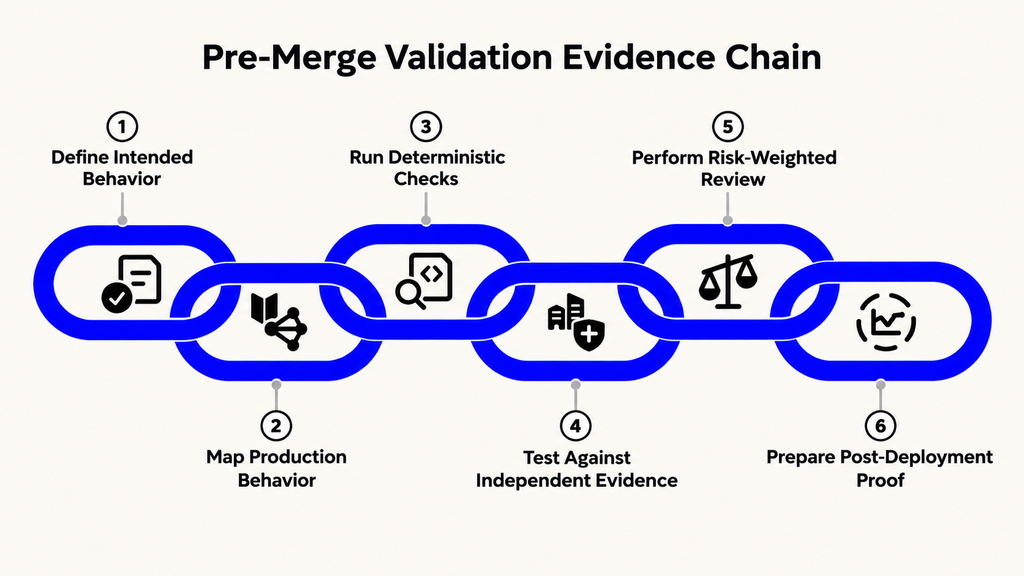
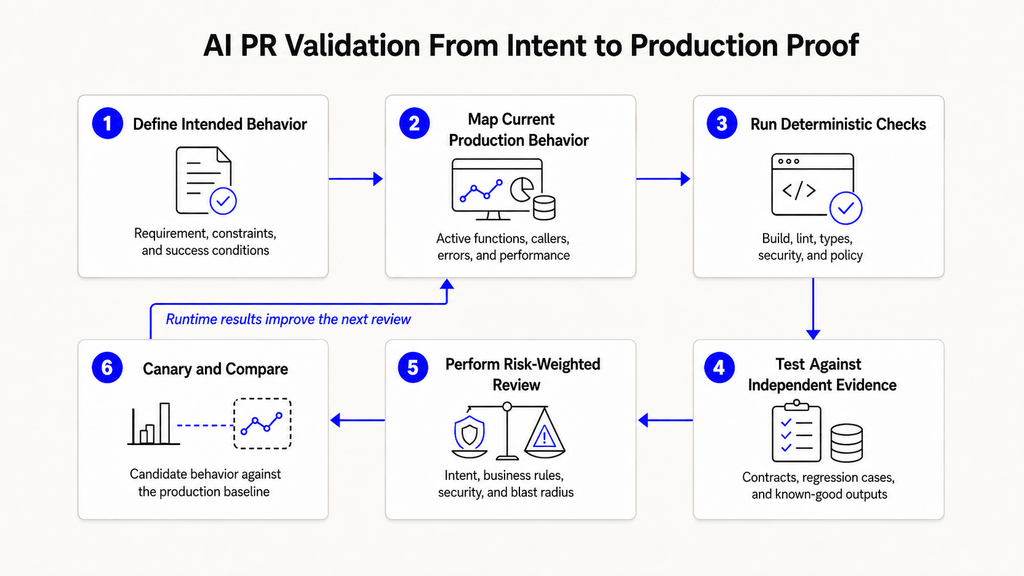
A strong workflow starts before the edit. It records intent, gathers independent evidence, and assigns checks based on runtime risk. For the payment retry PR, that means defining the expected rate-limit behavior, checking how the helper is used in production, testing the change against independent evidence, and deciding what to monitor during rollout. The process forms an evidence chain from intended behavior to post-deployment verification.
1. Define the Intended Behavior Before Generation
Add acceptance criteria to the ticket or PR template before the agent starts. For the retry helper, specify how to handle rate limits, cap retries, and preserve the same idempotency key across attempts. Define the expected result for each case. Product and engineering owners should agree on these criteria before generated tests are treated as evidence.
You can also limit the scope. Reject or separate out unconnected refactoring. Smaller focused changes are easier to trace back to an explicit requirement.
2. Map the Proposed Diff to Current Production Behavior
List the changed functions, then use a tool such as Hud to inspect their invocation counts, durations, exceptions, and call relationships. Record the production environment and observation window alongside the findings. Reviewers can inspect the data in Hud or their IDE; agents can access it through Hud’s MCP integration.
For the retry helper, identify which callers use it and where failures occur. Use those findings to select integration tests and rollout monitoring. Missing telemetry means the impact is uncertain, not that the function is unused.
3. Run Deterministic Checks
Build the code, then run formatting checks, linting, type checks, secret scans, dependency analysis, and security rules. Add checks for architectural boundaries. These are the most important fast, repeatable gates.
In addition, automated code review can apply predefined rules consistently, explain a diff, and highlight areas that require attention. However, it’s important to understand that it cannot reliably determine whether a particular code path matters in production or whether the specification itself is incomplete.
4. Test Against Independent Evidence
Run unit, integration, contract, and regression tests. Add sanitized cases from incidents and active production patterns. Consumer-owned contracts help avoid relying solely on provider assumptions. For the payment retry PR, an independent contract test can return HTTP 429 with a Retry-After header and verify that the helper waits according to the provider contract before trying again.
AI-assisted testing can help generate variations of input, fuzz cases, and provide more coverage. However, this is not sufficient evidence when the same agent creates the implementation and expected outcome, since the same incorrect assumptions can affect both. The test oracle should come from a human-approved contract, known-good output, or independent consumer expectation.
5. Perform Risk-Weighted Review
An AI PR review can explain a diff, trace data flow, compare code to the task, and flag likely failures. A human should review based on intent, business rules, security boundaries, irreversible operations, and conflicts with runtime evidence taken into account. The depth of review should be driven by operational risk, not by number of lines.
So, it is important to use simple blocking rules depending on the level of risk. Authentication, billing, destructive paths, unstable dependencies, and high-volume functions need stronger approval and a rollout plan. For changes reversible on low-activity paths, the review process may be lighter.
6. Prepare the Post-Deployment Proof Before Merging
Some behavior can only be validated under realistic traffic. Define the canary population, comparison window, watched functions, error types, latency limits, and rollback condition inside the PR. Decide what success means before deployment results are visible.For the retry change, that could mean exposing the new behavior to a small share of checkout traffic and watching payment failures, retry activity, and tail latency before expanding the rollout.
After deployment, compare the candidate with the baseline. Watch for new exceptions, changed calls, tail-latency shifts, and unexpected activity. This closes the loop without pretending current telemetry predicts every production outcome.
What Good AI PR Validation Looks Like at Scale
At scale, every change follows the same evidence model, without requiring the same review process. The platform can classify risk using runtime activity, dependency reach, data sensitivity, reversibility, and incident history. Policy can then determine the required tests, reviewers, and rollout controls.
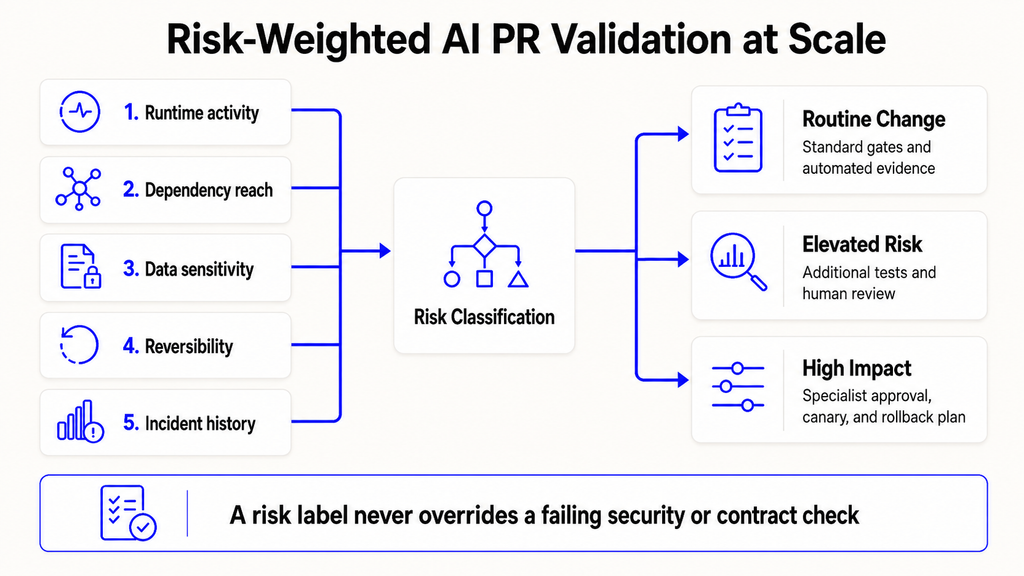
Reviewers need a compact record of intent, affected runtime paths, results, warnings, and planned production checks. They should not reconstruct the agent’s reasoning from a huge difference. An AI pull request touching checkout needs different evidence from one updating an unused command.
The feedback loop matters as much as the gate. Connect new exceptions or latency shifts to the responsible PR. Turn relevant incident inputs into regression tests and performance changes into benchmarks, then provide that evidence to the next agent task. AI SRE tools can correlate operational signals, while function-level runtime intelligence, such as Hud, narrows those signals to the affected code paths.
The mature end state is not zero human review. It is fewer generic reviews and more focused decisions. Agents handle repeatable checks, and platform rules prevent known unsafe actions. Then engineers can spend their time on intent, architecture, and consequences that cannot be reduced to a passing status.
FAQ
Is Code Review Sufficient to Validate AI-Generated PRs?
Not by itself. A reviewer can see bad logic, unnecessary changes, or code that’s going to be difficult to maintain. But some issues only come up when the code is run with real data and dependencies. Tests, contract checks, runtime evidence, and careful monitoring after deployment are still necessary.
How Does Static Analysis Differ From Runtime Validation for PRs?
Static analysis checks code without running it. It is useful for catching type errors, unsafe patterns, policy violations, and known vulnerability patterns. Runtime validation examines what happens during execution, what functions are called, how long they take, and where failures occur in real operating conditions.
Can a Coding Agent Review Its Own PR Reliably?
A coding agent can review its diff, explain its choices, and catch obvious mistakes. The problem is that it may rely on the same incorrect assumption it used when writing the code. An independent specification, separately maintained tests, automated checks, and human approval provide a more reliable safety net.
Does the Review Process Change When Agents Ship PRs Continuously?
Yes. Reviewing every agent-written PR with the same level of effort quickly becomes impractical. Teams need smaller changes, automatic evidence collection, and risk-based review rules. Routine updates can be quick, while changes in security, payments, or heavily used code paths get more human review.
What Regressions Do AI Coding Agents Most Commonly Introduce?
Typical risks include missed edge cases, broken service contracts, weak error handling, permission changes, unnecessary dependencies, and slower performance on busy paths. An agent may even rewrite a test so that an incorrect implementation passes. Production behavior and previous incidents help reveal which risks matter most for a specific system.
About authors