Today, AI coding agents can inspect a ticket, read files, suggest a fix, write tests, and prepare a pull request. It speeds up development, but reliability is still questionable depending on what the AI agent is able to see.
Many production failures come from code that looks clean, passes review, and still behaves badly under real traffic. The agent understands the code base insight out. But it may not understand the complete running system. That is why production runtime context matters. Agentic coding can become safer when agents can see how software behaves after it ships at runtime.
Key Takeaways
- Static code gives agents structural insights, but it does not always explain real traffic, latency, dependency behavior, or production failure patterns.
- Production runtime context helps agents understand which functions are critical, which paths are risky, and where previous changes caused problems.
- AI agent reliability depends on the quality of context available during planning, code generation, review, and remediation.
- Runtime intelligence fits best as a grounding layer between production behavior and agentic coding workflows.
What Agentic Coding Actually Means for Engineering Teams Shipping Code Today
In modern development, agentic coding can work towards a goal, moving through several steps. It’s not always linear. Agents can work in cycles, loops, or even wait for human input for clarifications. It may inspect a bug report, search the codebase, make changes, and open a pull request. The developer is still involved, but the agent is doing more of the execution.
However, it’s still risky because software changes rarely stay isolated. Think of the following scenarios.
- A small helper function may affect a queue consumer.
- A new database query may look harmless in review, then become expensive at production scale.
The issue is not that the agent cannot read code. The issue is that repository context alone does not show how the change behaves under real production traffic.
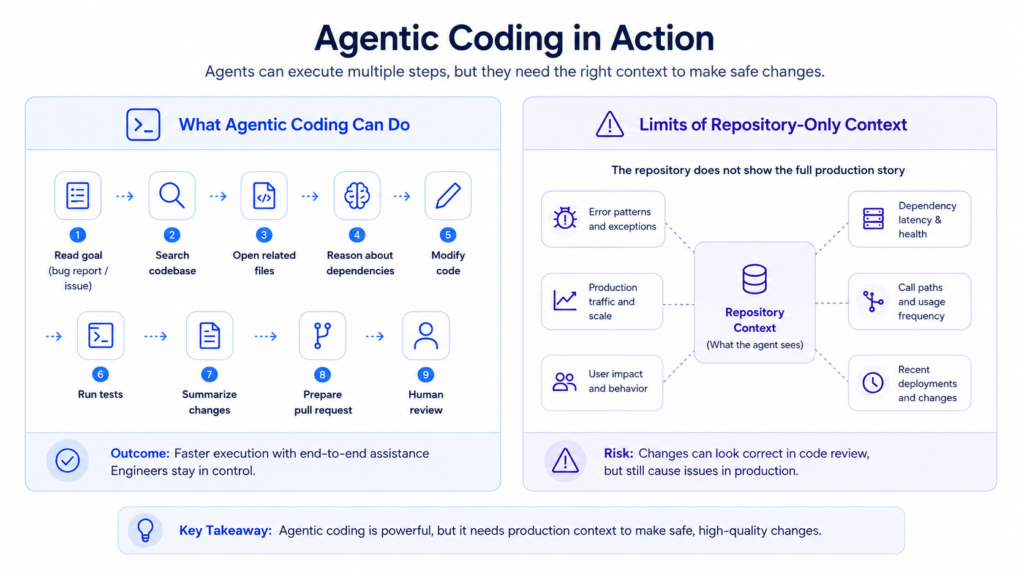
Anthropic explains in effective context engineering for AI agents that context engineering includes instructions, tools, external data, history, and Model Context Protocol access. For engineering teams, the lesson is direct. Agents do not need unlimited context. They need the right context.
That might include the affected function, the call path, the error pattern, or the fact that a small helper is used by a high-volume endpoint. Without those signals, an agent may produce code that is logical and still risky.
What Production Runtime Context Gives an Agent That Static Code Cannot
Static code tells an agent what can happen. Production runtime context tells it what does happen. A repository shows modules, imports, tests, route handlers, comments, and abstractions. That helps an agent reason about structure and intent.
But the production systems can behave differently from their design.
- A function that looks small may sit on a critical request path.
- A downstream service that looks non-critical in the code may still block checkout when it fails in production.
- A database query may be fine for small datasets and painful at real scale.
- A branch may create latency only for one feature flag, customer tier, or payload shape. Static code usually cannot show that.
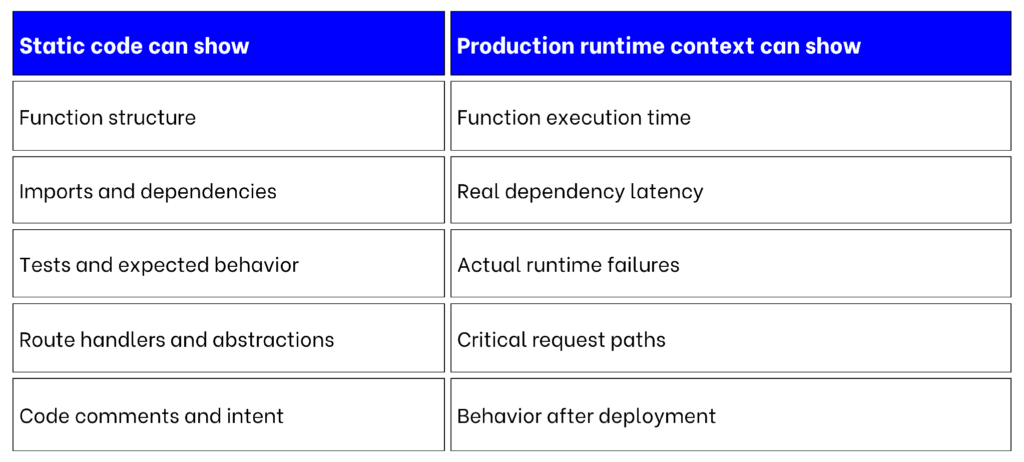
Production runtime context can include function execution time, unhandled exceptions, error spikes after deployment, caller and callee relationships, dependency latency, queue slowdowns, request patterns, payload shapes, and representative execution flows.
Real-time, function-level runtime context gives developers and code-generating agents a clearer view of how production behavior changes over time. That context helps agents connect a code change to runtime signals such as slow execution paths, exceptions, downstream service behavior, and production regressions.
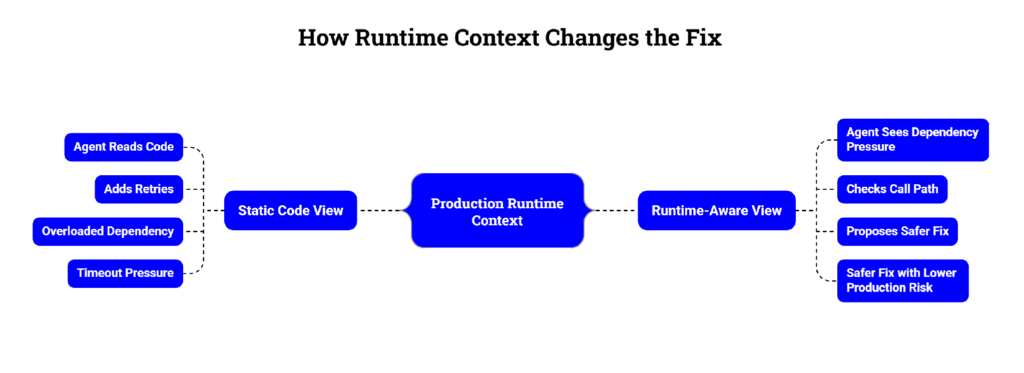
Consider a scenario where an agent is asked to fix a timeout in a billing service. From static code, it may add retries around a slow downstream service. Runtime context might show that the downstream service is already overloaded during traffic spikes, so retries would make the problem worse. The agent needs that distinction before it writes the patch.
Broad observability data is not always enough for agentic coding. Dashboards, alerts no, logs, and traces are often designed around human investigation. An agent needs a smaller, more specific context that connects production behavior to the exact function, file, or path it is working on.
Therefore, it’s important to use runtime guardrails for AI coding agents. Agents may see code, tests, and documentation, but still miss which functions are heavily used, what sits on a critical path, and how a change can spread across services.
How Teams Are Using Runtime Data to Make Agentic Coding Reliable at Scale
Most engineering teams do not start by handing over full autonomy to AI coding agents. They start with constrained workflows.
An agent may be allowed to draft a fix but not merge it. It may suggest test coverage but not change production code. We often look at the risks involved and delegate low-risk refactors, dependency bumps, or CI failures in the beginning. Over time, teams look for ways to expand the scope safely. The blocker is trust. Not trust in a vague sense, but trust based on evidence.
- Can the agent understand the blast radius of its change?
- Can it see whether the modified function is on a high-volume path?
- Can it explain why the fix addresses the production behavior, not only the visible error message?
- Can it avoid touching unrelated files?
- Can it produce a pull request that a human reviewer can evaluate quickly?
Runtime data helps answer those questions. A practical agentic coding workflow might look like this:
- A production issue appears after a deployment.
- Runtime intelligence can help identify the affected function and related call path.
- The AI coding agent receives the issue, the relevant code, and the runtime context.
- The agent proposes a small fix and explains the production behavior behind it.
- CI runs tests and static checks.
- A human reviewer checks the diff, the risk, and the agent’s reasoning.
The team ships the fix and watches whether the runtime signal returns to baseline. This is not full automation. It is a controlled loop. The point is to give the agent enough real-world context to make better decisions while keeping engineering review in place.
The CodeGeeks article on agentic context engineering describes techniques such as selecting only relevant context, compressing accumulated history, and isolating sub-agent contexts so failures do not spread across a pipeline. Those patterns are useful here because production data can become noisy if it is not filtered well.
A coding agent does not need to consume the whole observability stack. It needs selected runtime facts that match the task.
- For a performance regression, that might mean the exact function where duration changed, the baseline behavior before deployment, the caller path, and a few representative inputs.
- For an exception spike, it might mean the new exception type, affected endpoint, related deployment, and code flow.
- For a queue slowdown, it might mean the consumer function, payload type, dependency timing, and downstream effect.
The more precise the runtime context, the more useful the agent becomes. This changes the review process too. Instead of reading an AI-generated pull request and wondering whether the agent guessed correctly, the reviewer can ask a sharper question: does this fix match the production evidence?
That is a better review frame. It is closer to how senior engineers debug. They do not only ask whether the patch is syntactically correct. They ask whether it explains the behavior seen in the system.
Final Thoughts
Agentic coding will not become reliable only because models improve at generating code. The context around the model matters just as much. Static code, tests, documentation, and tickets are still important. But production runtime context fills a gap those sources cannot cover. It shows how the system behaves under real traffic, real dependencies, and real failure conditions.
When AI coding agents can see that behavior, their suggestions become easier to judge. Their fixes become more grounded. Human review still matters, However review becomes less blind.
FAQ
Why do AI agents ship fixes that break in production?
AI agents can ship fixes that break production when they reason from incomplete context. They may see code, tests, and issue details, but not real traffic, latency, dependency behavior, or runtime failure patterns. The fix can look correct locally while changing a critical production path the agent never saw.
What does production runtime context actually include?
Production runtime context includes real behavior from running software. It can include function duration, exception patterns, relationships across endpoints and services, endpoint impact, downstream service timing, queue behavior, deployment changes, and execution flows.
How do AI coding agents access live production data?
AI coding agents usually access selected production runtime data through controlled tools, APIs, or MCP servers. The goal is not to expose raw logs or full production data to the model. A stronger approach gives the agent task-relevant signals, such as affected functions, behavior changes, error patterns, and related call paths.
About authors