
Runtime Security

Picture launching a powerful AI application, training it on vast data, checking for bias, validating for accuracy, and then never watching how it behaves once it’s live. In the era of generative AI, that’s what shipping software without runtime security looks like. Models rarely break at build time; they break when real people interact, prompts mutate, and adversaries push boundaries.
Runtime security is the safety net that defends software while it’s running, including AI systems built on large language models, autonomous agents, or AI-generated code. As organizations deliver software where decisions are made dynamically by models, runtime protection becomes essential for observing behavior, catching abuse, and shutting down threats on the spot.
What Is Runtime Security?

Runtime security safeguards applications, workloads, and models during execution. Instead of analyzing static code or container images, it monitors real behaviour: what the system actually does when genuine users and data are in play.
For AI-centric platforms, runtime security reaches beyond infrastructure signals to track how models behave in production, such as:
Prompt inputs and generated outputs.
- API calls or tool invocations triggered by LLMs.
- Execution of AI-generated code.
- Data-access patterns during inference.
- Surprising model actions or decision paths.
Key runtime-security functions include:
- Visibility: Streaming real-time telemetry for processes, network traffic, file access, model I/O, and tool usage.
- Detection: Spotting anomalies like prompt injection, data exfiltration, unauthorized tool use, or rogue AI-generated code.
- Prevention & Response: Blocking malicious requests, isolating compromised workloads, or suppressing unsafe model outputs in milliseconds.
Because runtime security focuses on behavior rather than assumptions, it uncovers issues that static testing can’t, especially when a model’s responses shift with context.
Runtime Security vs. Pre‑Deployment Security
Security starts long before production. Static analysis, dependency scans, model evaluation, prompt testing, and policy checks are all examples of pre-deployment controls that aim to identify risks before code is released. These “shift-left” methods are very important, especially when AI makes code and prompts.
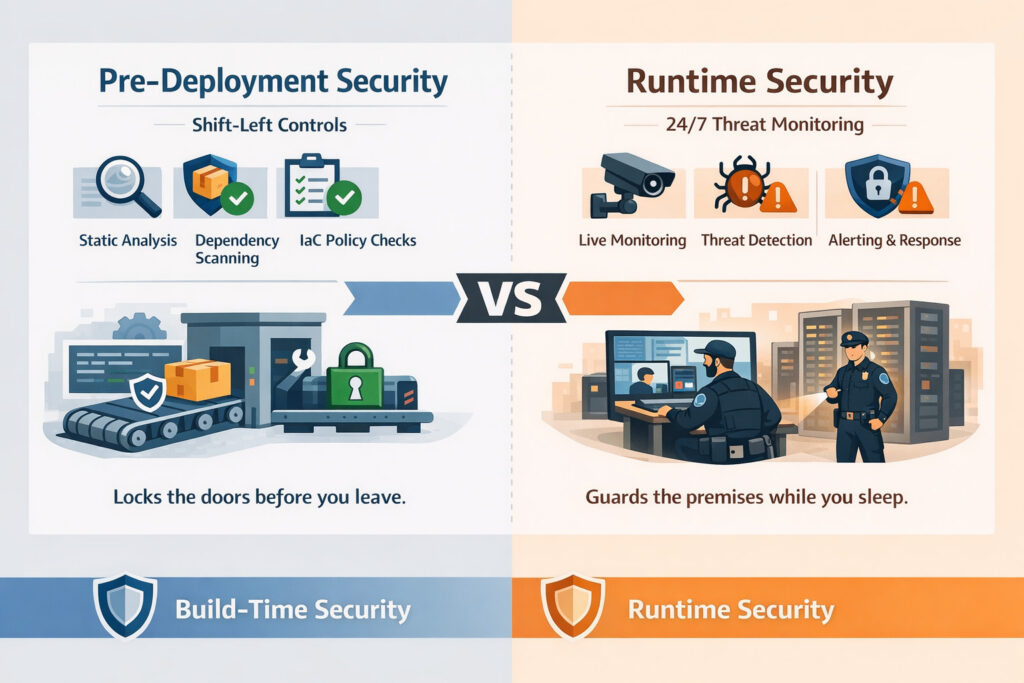
Yet AI systems behave differently once they’re live. Runtime security closes the gap between what you tested and what actually happens:
- Focus: Pre-deployment runs during build, test, and CI/CD. Runtime runs in staging or production, often just a few milliseconds before damage can happen.
- Timing: Pre‑deployment runs during build, test, and CI/CD; runtime runs in staging or production, often within milliseconds of damage occurring.
- Primary Goal: Pre‑deployment aims to prevent known issues from shipping. Runtime aims to detect and stop active abuse or emergent behavior.
- Typical Tooling: Pre‑deployment uses SAST, SBOM analysis, and image scanners; runtime leans on eBPF‑based agents, RASP sensors, and cloud‑native runtime guards integrated with CSPM or SIEM platforms.
- Main Benefit: Pre-deployment reduces risk in advance, while runtime security shields against unpredictable interactions and evolving attacks.
Think of it this way: pre-deployment security checks what you built. Runtime security watches what your AI system actually does.
Key Benefits of Runtime Security Tools
- Immediate Threat Detection: Live monitoring flags attacks the moment they occur, from prompt-injection attempts to malicious AI-generated code, reducing mean-time-to-detect.
- Protection From AI-Specific Attacks: Advanced platforms can stop rogue processes, quarantine containers, or cut off network access without human intervention.
- Safe AI Autonomy: When LLMs write code, invoke tools, or trigger actions, runtime guardrails ensure they don’t exceed their permitted scope.
- Lower Operational Risk: Automated containment, such as blocking responses, killing processes, or quarantining containers, limits the blast radius without human delay.
- Compliance & Auditability: Continuous logs of decisions, actions, and data access support SOC 2, GDPR, HIPAA, and emerging AI-governance audits.
- Unified Visibility: In AI-heavy environments, tools like Hud.io help keep things safe while they’re running by showing how code and AI-driven workflows actually run at the function level. This helps teams determine what caused strange behavior in a model or agent by examining the exact runtime paths and conditions that triggered it.
Conclusion
In AI-powered systems, runtime security is no longer optional. When models generate code, invoke tools, and make split-second decisions, the biggest risks emerge after deployment.
By observing live behavior and enforcing safeguards in real time, runtime security bridges the gap between lab assumptions and production reality. Paired with strong shift-left practices, it delivers end-to-end defence, keeping AI apps safe, reliable, and trustworthy.
FAQ
How does runtime security differ from static testing?
Static security checks study code, models, and dependencies before anything runs, catching known flaws but only under lab assumptions. Runtime security, by contrast, observes the application in production, watching every prompt, output, system call, and network request. It can detect prompt injection, data exfiltration, or rogue code the moment they occur and block them instantly.
Is runtime security necessary for containerized AI services?
Yes. Containers create isolated environments quickly, but AI endpoints inside them can be exploited just as fast. Runtime security instruments the container’s kernel and user-space activity, tracing system calls, network flows, and file access. It prevents privilege escapes, model misuse, and configuration drift, giving teams clear forensics and automated containment even when pods churn rapidly.
How does cloud runtime security protect live workloads?
Cloud runtime protection deploys lightweight agents or eBPF programs that stream low-level telemetry like process events, network packets, file ops to a detection engine. Policies written for AI workloads evaluate this stream in real time, watching prompts and outputs alongside OS signals. When a violation appears, the platform blocks traffic, isolates instances, and records evidence for audit.
Can runtime-security tools respond automatically?
Absolutely. Advanced runtime platforms pair detection rules with enforcement actions wired directly into the process namespace, service mesh, or container runtime. If they see prompt injection, suspicious tool invocation, or privilege escalation, they can kill offending processes, reject API calls, quarantine pods, or mute unsafe model outputs dramatically shrinking mean-time-to-respond.