
AI SRE

Production incidents rarely come with an explanation. Say a checkout service starts timing out. Latency at p99 jumps from 200 ms to two seconds, and three dashboards each show something different. The on-call engineer has to figure out which one to trust.
AI SRE uses AI to do that digging. It pulls together enough production evidence for the engineer to see what broke.
What Is an AI SRE?
An AI SRE is an AI-assisted or agent-based system for reliability work: alert triage, incident investigation, root cause analysis, and small, controlled fixes. It reads logs, metrics, traces, deployment changes, runbooks, dependency data, and past incidents.
Compared to traditional automation, agentic SRE can take action based on more than just hard rules. For example, with a payment service timeout, an agentic SRE can determine that the payment service isn’t the cause of the failure and help suggest possible root causes.
How AI SRE Works Within Modern Incident Management
Modern incident management systems utilize AI SRE to help with various parts of an incident. AI SRE systems capture telemetry and then check recent changes to help determine possible root causes. They then help suggest incident actions. Because of the degree of autonomy, most systems begin by creating a read-only policy, then add approval-based actions, and finally autonomous actions.
Everything depends on what the agent can see. Traces and metrics only capture what has been instrumented, collected, and sampled. Suppose the payment service only logs “request failed.” The agent finds the deploy but can’t see which change in the deploy caused the problem.
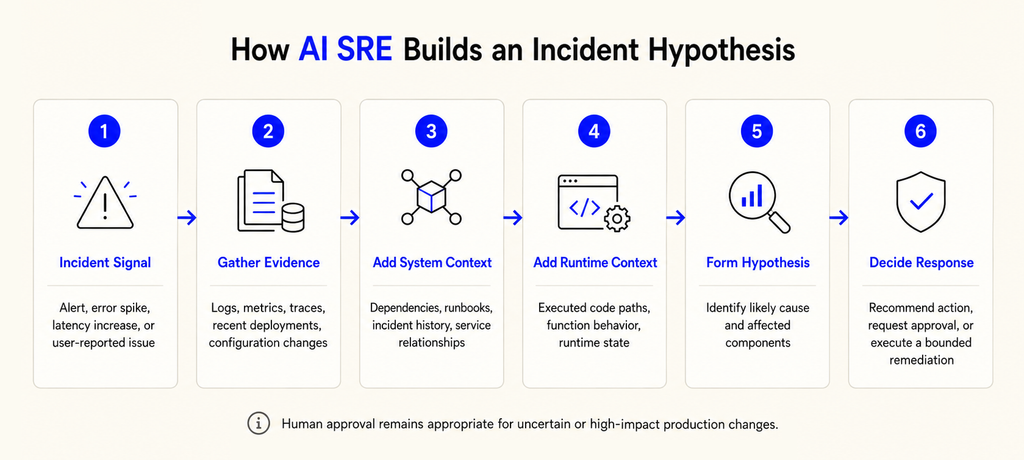
Runtime context adds function-level metrics and forensic data from the code that actually ran during the incident. Hud gives AI SRE agents this context, so the checkout timeout from our example can be traced to the affected code path. When comparing AI SRE tools, ask what context each one collects and what actions it can take.
Key Benefits and Limitations of AI SRE
AI SRE helps most with the steps on-call engineers repeat:
- Faster triage – Groups related alerts and recent changes before anyone opens a dashboard.
- Consistent investigation – Checks dependencies, deploy history, and runbooks the same way on every shift.
- Less toil – Takes on routine evidence gathering, summaries, and low-risk fixes.
- Better incident records – Keeps the timeline, decisions, and suggested actions for the post-incident review.
However, it can provide incorrect suggestions. AI incident response can go wrong if telemetry has gaps. Depending on the edge cases and failure modes, human intervention may be necessary. New failures, changes with unknown impact, and risky changes still require human intervention. Set permission limits on autonomous systems.
Who Relies on AI SRE and Why
SRE teams use it most, but platform engineers, DevOps teams, service owners, and developers on call benefit too. Their shared problem is time. Linking signals across systems is slow, especially when the incident is still live.
Teams with many services and frequent deploys have the most to piece together. Their application monitoring tools may already show metrics, traces, errors, and requests. Automated SRE helps them work through it. Runtime context matters when that telemetry misses the exact code path or execution state behind a failure.
Final Thoughts
AI SRE is a layer for investigation and automation built on top of reliability engineering. Repeatable tasks become faster and easier to accomplish, while time spent on unstructured work decreases. AI SRE’s confidence level, coupled with the telemetry it can see, limits its capability. You can’t guarantee 100% confidence in telemetry, and a runtime failure or edge case can still cause an incident. Hud gives agents that function-level, production runtime context. To see what your agents have been missing, try Hud.
FAQ
What is the difference between a traditional SRE and an AI SRE?
A traditional SRE owns reliability. They make the incident call. AI SREs are software agents. They point to potential causes and collect evidence. An AI SRE can perform the grunt work of digging through logs to find the root cause. A human SRE retains the judgment and risk.
Can AI SRE fully replace human site reliability engineers?
No. AI SRE can help narrow the focus, but most incidents require judgment and the ability to coordinate. For example, humans decide whom to bring into an incident, when to escalate, or if they should take a risk and make an unplanned change. These decisions often rely on context the AI can’t understand.
What kinds of incidents is AI SRE best suited to handle?
Ones with a familiar pattern and enough production data behind them. A failed deploy, a dependency timing out, or a known resource issue are good examples. Odd failures with poor instrumentation or no runtime context are much harder to pin down.
How does AI SRE integrate with existing observability and alerting tools?
It usually sits on top of a team’s existing tools. An alert kicks off the investigation, and the AI SRE pulls in metrics, traces, logs, and deploy history. The engineer sees it all connected in one place.